Iran’s MEK to open Washington office

The “People’s Mujahideen” or Mujahideen-e Khalq Organization (MEK) went from being listed as a terrorist organization for years to moments later opening up an office in DC.  I wonder what they had to do in order to get the official and public Western aplomb. Lets look at their 10-point future plan for clues. The MEK, believe it or not, now stand for a “market economy.”  The MEK used to be a group that advocated for a “towhidi” classless society in which “the people” controlled the means of production and a MEK-led Iran meant a radical redistribution of wealth in one of the most stratified countries in the world, Iran.  Additionally, take a look at this point: “a foreign policy based on peaceful coexistence, international and regional peace and cooperation.” They might as well recognize Israel now. I mean, they’ve been working hand-in-hand with Zionism to topple Iran’s government. What’s funny is that some of the pre-revolution MEK fighters were trained by Arafat’s Fatah armed group when it was based in Lebanon in the 70s. They hated the Shah, amongst other reasons, for his support of Israel. At this point it’s safe to say that MEK will sell all its founding principles in order to gain American and Israeli support to topple the government. Oh how the Rajavis, the longstanding rulers of the MEK, have betrayed the MEK’s origins.

The Hill: The Iranian opposition group MEK is opening an office in Washington after the State Department dropped it from its terrorist list last fall.

The National Council of Resistance of Iran, an umbrella group of five Iranian opposition groups, announced Tuesday that it is opening a DC office as part of “the Iranian resistance’s expanding efforts inside and outside Iran.” The Mujahedin-e-Khalq (MEK) is the largest organizational member in the council, according to Near East Policy Research, a pro-MEK group that distributed an invitation to the council’s open house reception on Thursday.

The State Department closed the council’s Washington office in 2002, calling it a front group for the MEK. Since then, the group has earned the good graces of U.S. conservatives by drawing international attention to Iran’s clandestine uranium enrichment facility in Natanz.

Secretary of State Hillary Clinton removed the MEK from its terrorist list last September after an intense lobbying campaign that included millions of dollars paid to prominent lawmakers and former government officials. The group has been accused of killing Iranian civilians and targeting U.S. business and diplomatic interests during the time of the Shah but has since renounced violence.

The council, which labels itself as Iran’s Parliament-in-exile, was founded in Tehran in 1981 and is based in Paris.  It says its aim is to replace Iran’s theocracy with a “democratic, secular and non-nuclear republic.”

“The opening of the office is consistent with the Iranian resistance’s expanding efforts inside and outside Iran, aimed at bringing democratic change to Iran and the timing could not be better with the failure of the nuclear talks and the upcoming Presidential elections in Iran,” the group said. “It [is] of course, more than just opening an office. It sends the strong political message to Tehran that the real Iranian opposition is back in business. And is just across from the White House.”

The council will hold an open house reception hosted by its U.S. representative, Soona Samsami, on Thursday.

Speakers include former Sen. Robert Torricelli (D-N.J.) and Rep. Patrick Kennedy (D-R.I.) and a host of former State Department officials of both parties, including U.S. Ambassador to the U.N. John Bolton as well as John Sano, the CIA’s former deputy director for Clandestine Services.

According to the council, its Ten-Point Plan for the Future of Iran:

  • emphasizes on ballot box as the only criterion for legitimacy;
  • a pluralist system;
  • respect for all individual freedoms;
  • separation of religion and state;
  • complete gender equality, including women’s right to choose their clothing, freedom in marriage, divorce, education and employment;
  • rule of law and justice;
  • commitment to Universal Declaration of Human Rights;
  • a market economy;
  • a foreign policy based on peaceful coexistence, international and regional peace and cooperation; and
  • a non-nuclear Iran, free of weapons of mass destruction.
Posted in Iran | Comments Off on Iran’s MEK to open Washington office

Iraq’s Branch of Al Qaeda Merges With Syria Jihadists

I have long said that the war in Syria is very much connected to Iraq. Now, unfortunately, it’s official. A lot of the jihadists fighting in Syria are jihadists who fought in Iraq but were driven out of the country into neighboring Syria by the so-called “Awakening Councils” (also known as the “Sons of Iraq”). Unable to defeat the insurgency, the US occupation force in Iraq made the tactical decision to buy off those Sunni fighters who were willing to be bought. Many Iraqi Sunnis were disgruntled with the occupation not only because it was a foreign military occupation, but also because the US disbanded the Iraqi army and banished the Baath Party, many members of which were Sunni Iraqis. These people lost their livelihoods at the hands of a foreign army. Thus, in the latter stages of the war with the US bogged down and running out of options, it bought and further armed Sunnis, many of whom had American and Iraqi blood on their hands, to form neighborhood councils and fight and root out the jihadists who couldn’t be bought. Many jihadists were indeed rooted out and they subsequently headed for neighboring countries where they sat and licked their wounds. Some joined other struggles like in Libya in 2011, but now many have brought their ideology and battle-experience to bear in the Syrian War, which for many has been there adopted home. The long-term strategy is to win the war in Syria en route to redemption in Iraq. Indeed, many of the these jihadists who lost in Iraq seek victory in Syria as a stepping stone to re-igniting the war in Iraq.  Today’s announcement that the Nusra Front is one and the same as al-Qaeda in Iraq attests to the transnational jihad unfolding before our eyes. NYT: Iraq’s branch of Al Qaeda said Tuesday that it had merged with the Nusra Front, a group of jihadists fighting to topple President Bashar al-Assad of Syria, in a marriage that appeared to strengthen the role of Islamic militants in the Syrian insurgency and further complicate Western assistance efforts.

The United States has already blacklisted the Nusra Front over evidence of its links with the Islamic State of Iraq, the Qaeda branch. But the news of the merger, made by the branch’s leader, Abu Bakr al-Baghdadi, in an audio statement posted on jihadist Web sites, was the first time he had announced that they were a single organization.

“The time has come for us to announce to the people of the Levant and to the whole world that Al Nusra Front is merely an extension of the Islamic State of Iraq and a part of it,” Mr. Baghdadi said. He also said the combined group would be called the Islamic State in Iraq and the Levant and would dedicate half its budget to the Syrian insurgency.

In a warning to other Syrian fighters who want Mr. Assad to go but do not share Mr. Baghdadi’s views, he said, “Don’t make democracy a price for those thousands among you who have been killed.”

The warning was quickly rejected by the Free Syrian Army, the rebels’ main fighting organization, which has sought to distance itself from the jihadist groups. “No one has the right to impose any form of state on Syrians,” said Louay Mekdad, a spokesman for the Free Syrian Army. “Syrians will go to the polls to choose their leaders and form their own state.”

Mr. Baghdadi’s announcement came as a backlash appeared to be spreading in Syria over the indiscriminate civilian killings believed to be carried out by jihadist groups, including the Nusra Front, aimed at further weakening Mr. Assad’s power in the two-year-old conflict. These groups have fearsome fighters but do not take orders from the Free Syrian Army, which has criticized attacks on civilians including a recent spree of deadly car bombings.

The jihadist merger also comes as Secretary of State John Kerry hinted during a trip to the Middle East and Europe that the United States was preparing to step up its assistance to the Syrian rebel cause.

While the United States and other Western nations have backed the Free Syrian Army and contributed nonlethal aid to its combatants, American officials have been reluctant to supply weapons, particularly because of concerns that they could fall into the hands of the Nusra Front or affiliates loyal to Al Qaeda. Differences in the degree of Western commitment to the insurgency have been a source of frustration to the Syrian political opposition.

The opposition movement also has struggled with its own divisions over rebel behavior. On Tuesday, the Syrian Observatory for Human Rights, an anti-Assad group based in Britain, accused a rogue insurgent battalion operating in Aleppo of arresting, torturing and extorting dozens of residents, mostly between the ages of 18 and 20.

“The Syrian Observatory demands that this battalion stop engaging in these practices immediately, as such behavior does not represent the values of the revolution,” said the group, whose information network inside Syria has emerged as a major source of insurgency news. “On the contrary, they are an extension of the oppressive and brutal methods practiced by the Syrian security apparatus.”

In Geneva, the United Nations refugee agency said Tuesday that the pace at which families are fleeing the destruction in Syria threatens to double or even triple the number of total refugees seeking shelter in neighboring countries by the end of the year. The agency also renewed an urgent appeal for money to deal with the crisis.

“The numbers look horrendous,” Panos Moumtzis, the refugee agency’s regional coordinator for Syrian refugees, told reporters.

A year ago, the number of Syrian refugees stood at 30,000, and the figure now exceeds 1.3 million, he said. With 200,000 people fleeing across Syria’s borders every month and no political solution in sight, humanitarian agencies fear that they will be trying to support up to three million refugees by the end of the year, Mr. Moumtzis said.

Posted in Iraq, Syria | Comments Off on Iraq’s Branch of Al Qaeda Merges With Syria Jihadists

Photos: Syria in Ruins

I visited Syria in the summer of 2008. I can’t believe large swaths of the country now amount to such harrowing images of destruction. See the photos here.

Posted in Syria | 1 Comment

A Journey to IRAN by ISA at Penn State University

This is a magnificent video compilation that captures Iran’s diversity, both cultural and geographical. It’s a nice change beyond the regular depictions of a menacing Iranian monolith.

Posted in Iran | Comments Off on A Journey to IRAN by ISA at Penn State University

Syrian government guerrilla fighters being sent to Iran for training

Reuters: The Syrian government is sending members of its irregular militias for guerrilla combat training at a secret base in Iran, in a move to bolster its armed forces drained by two years of fighting and defections, fighters and activists said.

The discreet program has been described as an open secret in some areas loyal to President Bashar al-Assad, who is trying to crush a revolt against his family’s four-decade hold on power.

Reuters interviewed four fighters who said they were taken on the combat course in Iran, as well as opposition sources who said they had also been documenting such cases.

Israel’s intelligence chief and a Western diplomat have said Iran, Assad’s main backer, is helping to train at least 50,000 militiamen and aims to increase the force to 100,000 – though they did not say where the training occurred.

No one at Iran’s foreign ministry was available for comment, but Iranian officials have repeatedly denied military involvement in the Syrian conflict, saying they have only provided humanitarian aid and political support for Assad.

A Syrian government security source, who declined to be named, denied that Syria was sending fighters to Iran. “We train our own special forces for this type of combat,” he said. “Since 2006 we have had units trained in guerrilla warfare, why would we need to send people to Iran?”

But if the reports by Syrian fighters are true, the move to train combatants in Iran suggests that their country’s increasingly regionalized conflict has grown well beyond – and could even outlast – a battle for power between Assad’s circle and the opposition.

The fighters also appear to come largely from minority groups that have supported Assad against the mostly Sunni Muslim-led uprising. Such a move could exacerbate the dangerous sectarian dimensions of a conflict that has turned into a civil war that has cost the lives of more than 70,000 people.

REGIONAL INFLUENCE

Iran, a Shi’ite rival to Sunni countries in the Gulf that support the rebels, sees Syria as the lynchpin of its regional influence. Syria has been its conduit to the Lebanese guerrilla movement Hezbollah, which fought a war with Israel in 2006.

“It was an urban warfare course that lasted 15 days. The trainers said it’s the same course Hezbollah operatives normally do,” said Samer, a Christian member of a pro-Assad militia fighting in rural parts of Homs province in central Syria.

“The course teaches you the important elements of guerrilla warfare, like several different ways to carry a rifle and shoot, and the best methods to prepare against surprise attacks.”

According to fighters interviewed in Homs, most men sent to undergo the training are from the Alawite sect, the heterodox strain of Shi’ite Islam of which Assad himself is a member.

A smaller number were Druze and Christians, whose communities are divided but largely support Assad due to their fears of rising Islamist rhetoric among the opposition.

“The Iranians kept telling us that this war is not against Sunnis but for the sake of Syria. But the Alawites on the course kept saying they want to kill the Sunnis and rape their women in revenge,” said Samer.

“DIE AN UGLY DEATH”

Syrian residents living in areas controlled by the army or militias say irregular forces have been increasingly “regularized” in recent months. These groups now brand themselves as the “National Defence Army” and seem to operate as a parallel force to the official armed forces – more lightly armed but without any of the oversight or responsibilities.

Since 2011, security forces organized groups called “popular committees” for neighborhood watches. These later became militias nicknamed “shabbiha”, from the Arabic word for ghost.

Shabbiha groups have been accused of some of the worst massacres of Sunni civilians, including one incident in the central town of al-Houla, in Homs province, in which more than 100 people were killed, half of them children. Authorities blamed rebels for the killings.

It is unclear how many former shabbiha fighters have been sent on courses in Iran, but some interviewees said they had assembled in groups of around 400 before being flown to Iran in smaller numbers. They believed the offer of training was open to many pro-Assad militias operating across Syria.

Syrian shabbiha fighters say Iran is also training Syrians and supporting their forces inside Syria, so it is not clear why courses have been run in Iran.

The fighters interviewed said they believed the training implied a growing crisis of confidence between Iranian forces and the Syrian army, which has been plagued with corruption as well as defections to the rebel side.

Nabeel, a muscular Christian fighter from Homs nicknamed “The Shameless One”, said Iranian trainers repeatedly lectured on looting, a crime widely committed by fighters on both sides.

“On our first day of training, the Iranian officer overseeing our course said, ‘I know exactly what is going on in Syria and want to tell you one thing: If you joined the National Defence Army for looting and not to defend your country, you will die an ugly death and go to hell’.”

SECRETIVE TRAINING

The trainees interviewed said they were divided into groups. Some trained as ground forces with automatic rifles and mounted anti-aircraft guns, others as snipers.

The groups were all flown from Latakia air base to Tehran International Airport and then directly bussed to an undisclosed location, they said.

“As soon as we arrived we were put on buses with windows covered by curtains and they told us not to open the curtains,” said the fighter Samer.

“We drove about an hour and a half before reaching the camp. It was straight from the airport to the camp, from the camp to the airport. We didn’t see anything other than that camp.”

All four combatants, who come from different towns and different militias, separately described the same experience. They said they were usually grouped into units of about 60 for training. The fighters said they were trained by Iranian officers who spoke Arabic but also relied on translators.

The units also had contact with Lebanese fighters, said the participants, who suspected those men of being Hezbollah militants helping to conduct training or participate in courses.

“There were some groups from Hezbollah training at the same base but there was no communication between our groups. They did their thing, and we did ours,” said Sameer, another militiaman from Homs. “I think their training was tougher than ours.”

GULF SEEKS TO “BLEED” IRAN

Iran has supported and helped train Syria’s army under long-standing military cooperation agreements, but a push into training its paramilitary forces could aggravate regional rivals such as Israel, which is particularly wary of Syrian groups increasing coordination with Hezbollah, or Saudi Arabia.

“If the Saudis felt that the Iranians are really moving this game up, they will be sure to check that escalation by increasing assistance to rebel fighters,” said Michael Stephens, a Doha-based analyst for the security think tank RUSI.

“Saudi Arabia is totally focused on this as a way to make the Iranians bleed … keep the Iranians bogged down in this proxy war, bleed them dry.”

The fighters described the training as far superior to skills they had been taught in courses inside Syria.

“Before I could only hit targets 50 percent of the time, now I can hit a target around 90 percent of the time,” said Samer.

“In Syria, they made the priority defending the place we are in, no matter the price. In Iran, they told us to save our lives. If you lose the position but survive, you can recoup and regain the site another day. If you die, your position will eventually be lost.”

Posted in Iran, Syria | 1 Comment

The Unknown Arab Uprising: Shia Muslims in Saudi Arabia Keep the Protest Movement Alive

The Global Post: Editor’s Note: When Arab Spring protests broke out in Saudi Arabia in 2011, the government reacted quickly. It pumped $130 billion into the economy, including hiring 300,000 new state workers and raising salaries. It also brutally cracked down on dissent, in some cases breaking up peaceful protests with live ammunition. While the carrot and stick approach worked in some cities, the Shia Muslims in the Eastern Province continued to protest. Shia make up some 10-15 percent of the Saudi population and have long rebelled against discrimination and political exclusion.

Demonstrations continued in the city of Qatif but got little publicity because foreign journalists are banned from reporting there. Correspondent Reese Erlich, on assignment for GlobalPost and NPR, managed to get into Qatif, meet with protest leaders and become the first foreign journalist to witness the current demonstrations. This is his account:

QATIF, Saudi Arabia — Night has fallen as the car rumbles down back roads to avoid the Saudi Army’s special anti-riot units. To be stopped at any of the numerous checkpoints leading into Qatif, would mean police detention for a Western journalist and far worse for the Saudi activists in the car. They would likely spend a lot of time in jail for spreading what Saudi authorities deem “propaganda” to the foreign media.

In Saudi Arabia all demonstrations are illegal, but here in Qatif residents have defied the ban for many months. At least once a week the mostly young demonstrators march down a street renamed “Revolution Road,” calling for the release of political prisoners and for democratic rights.

The anti-riot units deploy armored vehicles at strategic locations downtown. The word on this night is that if demonstrators stay off the main road, the troops may not attack.

Foreign journalists are generally denied permission to report from Qatif. Activists said this night was the first time a foreign journalist has been an eyewitness to one of their demonstrations. Asked if the troops will use tear gas, Abu Mohammad, the pseudonym used by an activist to prevent government retaliation, says, “Oh, no. The army either does nothing or uses live ammunition.”

I really hope it will be option #1.

Suddenly, young Shia Muslim men wearing balaclavas appear, directing traffic away from Revolution Road. All the motorists obey the gesticulations of these self-appointed traffic cops.

Minutes later several hundred men march down the street, most with their faces covered to avoid police identification. Shia women wearing black chadors, which also hide their faces, follow closely behind, chanting even louder than the men.

One of their banners reads, “For 100 years we have lived in fear, injustice, and intimidation.”

Despite two years of repression by the Saudi royal family, Shia protests against the government have continued here in the Eastern Province. Though Shia are a small fraction of Saudi Arabia’s 27 million people, they are the majority here. Most of the country’s 14 oil fields are located in the Eastern Province, making it of strategic importance to the government.

Shia have protested against discrimination and for political rights for decades. But the Arab Spring uprisings of 2011 gave new impetus to the movement. Saudi Arabia is home to two of Islam’s most holy cities, and the government sees itself as a protector of the faith. But its political alliances with the US and conservative, Sunni monarchies have angered many other Muslims, including the arc of Shia stretching from Iran to Lebanon.

Saudi officials claim they are under attack from Shia Iran and have cracked down hard on domestic dissent.

 Saudi authorities are responsible for the death of 15 people and 60 injured since February 2011, according to Waleed Sulais of the Adala Center for Human Rights, the leading human rights group in the Eastern Province. He says 179 detainees remain in jail, including 19 children under the age of 18.

The government finds new ways to stifle dissent, according to Sulais. Several months ago the government required all mobile phone users to register their SIM cards, which means text messaging about demonstrations is no longer anonymous.

Abu Zaki, another activist requesting anonymity, says demonstrators now rely on Facebook and Twitter, along with good old word of mouth. Practically everyone at the recent Qatif protest march carried iPhones. Some broadcast the demo in near real time by uploading to YouTube.

Organizers hope their sheer numbers, along with government incompetence, will keep them from being discovered. “The government cannot follow everybody’s Twitter user name,” says Abu Zaki. “The authorities have to be selective and, hopefully, they don’t select my name.”

When protests began, demonstrators called for reforms. But now, younger militants demand elimination of the monarchy and an end to the US policy of supporting the dictatorial king.

Abu Mohammad, Abu Zaki and several other militant activists, gather in an apartment in Awamiyah, a poor, Shia village neighboring Qatif. In this part of the world a village is really a small town, usually abutting a larger city. Awamiyah is one such town, chock full of auto repair shops, one-room storefronts, and potholed streets. It is noticeably poorer than Sunni towns of comparable size.

Strong, black tea is served along with weak, greenish Saudi coffee. The protest movement in Qatif, they observe, resembles the tea more than the coffee.

Abu Mohammad tells me protests have remained strong because residents are fighting for both political rights as Saudis, and against religious/social discrimination as Shia.

Shia face discrimination in jobs, housing and religious practices. Dammam, the largest city in the area, has no Shia cemetery, for example. Only six Shia sit on the country’s 150-member Shura Council, the appointed legislature that advises the king.

“As Shia, we can’t get jobs in the military,” says Abu Mohammad. “And we face the same political repression as all Saudis. We live under an absolute monarchy that gives us no rights and steals the wealth of the country.”

The government denies those claims of discrimination and repression. In Riyadh, Major General Mansour Al Turki, spokesperson for the Ministry of Interior, is the point man who often meets with foreign journalists. Al Turki is smooth and affable and practiced at the art of being interviewed by Westerners.

He dismisses Shia charges of discrimination as simply untrue.

“These people making demonstrations are very few,” he tells me. “They only represent themselves. The majority [of Shia] are living at a very high level.”

Such assertions, however, don’t account for the frequent and sizable Eastern Province demonstrations supporting Sheik Nemer al Nemer. The charismatic Shia cleric has long been a thorn in the government’s side. His willingness to speak out against discrimination and call for militant action endeared him to the younger generation of activists. For months he avoided arrest by shifting residences and only appearing in public during large rallies.

Then in July 2012 authorities made an arrest while he was briefly visiting his house in Qatif. He was shot and seriously wounded. Police claim it was an armed shootout in which they fired in self defense.

The Sheik was unarmed, according to his brother, Mohammad al Nemer. He says his brother hasn’t been publicly charged, but has been told that he faces a long jail term for instigating unrest against the king and organizing illegal demonstrations.

Four police bullets shattered his brother’s thigh bone, says al Nimer. “If he doesn’t receive proper medical care, he will have a lame leg for the rest of his life.”

Al Nemer’s popularity has grown exponentially since his arrest, with graffiti demanding his release sprouting up throughout the area and marchers regularly chanting his name.

Shia leader Sheik Mohammed Hassan al Habib offers understanding of the continuing protests. The cleric lives in a modest home on a side street outside Qatif. Sheik al Habib adds something special to the usual proffering of tea and coffee: Swiss chocolate.

Al Habib tells me that the Eastern Province movement seeks democratic reforms while maintaining the power of the monarchy.

“We need to give real power to the parliament,” he says. “The government should allow establishment of political parties, freedom of speech and assembly.” But the king would still have final authority, he concedes.

“We don’t want toppling or removal of the regime,” he emphasizes.

He acknowledges, however, that many younger protestors have given up on reform. For example, activist Abu Mohammad says, “People now want the overthrow of the ruling family as a reaction to the escalation of repression in Qatif. I think the best form of government for Saudi Arabia is constitutional monarchy like they have in Britain.”

While calling for a UK-style constitutional monarchy is rather tame by western standards, it’s treasonous in Saudi Arabia.

“People must complain through the legal process,” argues the Ministry of Interior’s al Turki. The legal process does not include calling for an end to the monarchy.

Al Turki adds that the opposition is controlled by Iran and seeks to establish a Shia Muslim dictatorship. The Iranian government does “affect such people,” he says. “But its influence is very limited.”

Al Habib denies the movement is directed from Iran. In fact, he criticizes the Iranian government for its treatment of demonstrators demanding democracy after the 2009 presidential elections.

“I was in Iran in 2009,” he says. “That was their legitimate right to demonstrate. The Iranian government should not have repressed them.”

But the “Iranian threat” remains a cornerstone of Saudi policy, justifying, for example, sending Saudi troops to neighboring Bahrain in March 2011 to help put down that country’s indigenous, Arab Spring uprising. It also justifies massive US military sales to the Saudi armed forces.

Because of oil riches, Saudi Arabia’s ruling family has been a high priority for US presidents dating back to Franklin Roosevelt. The US sent its first military mission to the kingdom in 1943 and began training Saudi troops in 1953. The US built up Saudi Arabia’s military as part of Cold War competition with the USSR. Saudi Arabia provided a steady flow of oil to the west; the US didn’t interfere with the royal family’s internal repression.

In recent times, Saudi Arabia has allowed the US to establish a drone base on Saudi territory, and it continues to receive massive US military aid.

In 2010, the US Congress passed legislation calling for $60 billion in military aid to the Saudis over 10 years. In 2011, the Obama administration allocated $30 billion of that to purchase US-made, advanced fighter jets and other hi-tech equipment.

Saudi Arabia spends 10 percent of its Gross Domestic Product on the military, ranking it third highest in the world on a per capita basis. Both US and Saudi leaders argue that such aid allows the kingdom to defend itself from outside attack.

Speaking of the $30 billion package, Andrew J. Shapiro, assistant secretary of state for political-military affairs, says the sales would “enhance Saudi Arabia’s ability to deter and defend against external threats to its sovereignty.”

Unfortunately, Saudi armed forces have not proven to be adept at such defense. When Iraq invaded nearby Kuwait in 1990, the Saudi military was virtually helpless in defending itself against the perceived threat. The US and European allies fought the Gulf War while the Saudis footed the bill.

Saudi Arabia’s arms have proven effective, however, in quelling domestic dissent. In response to the repression, the State Department report on human rights offers a pro forma list of “reported” problems in Saudi Arabia. “The most important human rights problems reported included citizens’ lack of the right and legal means to change their government….”

Activists sharply disagree with US support for the royal family, pointing to the difference between US stands on Syria and Saudi Arabia.

“America supports the royal family because they protect its interests,” says Abu Zaki. “The pressure is growing. People are getting angrier and angrier” at US policy.

The Saudi royal family used a combination of repression and economic improvements to quell protests that broke out around the country in 2011. Authorities announced a $130 billion spending program that would hire 300,000 more state workers, raise salaries, and build subsidized housing.

But neither government spending nor harsh crackdown have so far deterred the protesters in Qatif.

The demonstrators see themselves waging a political battle in which popular support can overcome the government’s repressive apparatus. The Shia of the Eastern Province are the only Saudis regularly holding protest marches, but as Shia cleric Al Habib tells me, Sunnis in other parts of the country also call for reform.

“We work with reformers who don’t care about your sect,” he tells me. “They look only for reforms. We hope Sunni and Shia will get together one day to pursue this goal.”

After a sip of black tea and a final piece of chocolate, we say goodbye to the cleric and head out to that night’s demonstration. Somehow we manage to avoid the checkpoints. And for that night, at least, there was no violence.

Posted in Arab Spring, Bahrain, Iran, Saudi Arabia, US Foreign Policy | Comments Off on The Unknown Arab Uprising: Shia Muslims in Saudi Arabia Keep the Protest Movement Alive

Iraqi Sunnis await a Baghdad spring

The Guardian: Abu Saleh sits in a striped tent pitched by the side of the highway joining Jordan and Syria with Iraq and reflects on the latest, improbable twist in his 10-year career fighting those he considers the enemies of his fellow Iraqi Sunnis.

A decade ago, when the Americans rolled into Ramadi in their tanks and Humvees, the former Saddam regime security officer led a group of Sunni fighters who took the fight to the occupiers with improvised explosive device (IEDs) and ambushes.

The scars of their insurgency are still visible in Ramadi’s industrial quarter: deserted shops riddled with bullet holes, metal shutters twisted like foil, black soot covering the walls.

But Abu Saleh and his fellow fighters lost their way, he says. “We made mistakes. We took people randomly. Some of us resorted to kidnapping to fund the resistance, then it became an industry, detaining people inside their neighbourhood, planting IEDs in front of people houses.” He explains how the resistance fragmented into competing groups, how they began to fight each other and al-Qaida and how their neighbours eventually turned on them.

By 2009 they had been, in effect, run out of town by a local militia hunting them on behalf of the Americans. Like thousands of other Iraqi Sunnis, Abu Saleh took refuge in neighbouring Syria.

Now in his mid-30s, Abu Saleh is back in Ramadi, borne on a tide that sprung from the revolutions of Tahrir Square and Benghazi and gathered force amid the bloodshed in Syria. Abu Saleh and other Iraqi Sunnis believe it is a tide that could flow all the way to Baghdad, sweeping away the Shia government they despise.

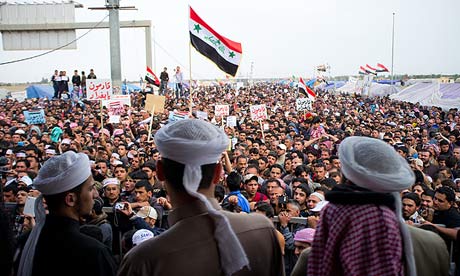
Outside Abu Saleh’s tent, a familiar scene unfolds. Thousands of men line the highway standing in long, neat lines praying on coloured prayer mats placed on the ground, in effect blocking the main route linking Iraq to Jordan and Syria.

After prayers the men gather in front of a podium planted in the middle of the road and demonstrators catalogue a long list of grievances: corrupt and brutal security forces who detain them at will, draconian anti-terrorism and “de-ba’athification” laws that are tailored to target their community, thousand of their sons and fathers languishing in prisons for years.

The grievances are punctuated by anti-Shia rhetoric, accusing them of being Iran’s agents, and threats to march on Baghdad. “Baghdad is ours and we won’t give it back!” the crowd thunders in response to one rabid orator after another. Some demonstrators wave Saddam-era Iraqi flags as lines of heavily armed soldiers and riot police look on.

Similar scenes have been played out in several Sunni cities in recent weeks in the runup to the charged 10th anniversary of the US-led invasion. Every Friday, thousands of peaceful demonstrators have poured into the streets of Ramadi, Mosul and Falluja mimicking the Arab spring protests elsewhere in the region.

In Mosul and Falluja, tent cities have sprung up in public squares. Some have even demonstrated in Sunni areas of Baghdad, braving the draconian Friday security measures imposed on them.

But perhaps more remarkable is the scene inside the tent. Among the tribal sheikhs and activists around Abu Saleh are former enemies and victims, men who feared him and men who hunted him on behalf of the Americans. Sensing an opportunity, Sunni factions have put aside their differences to mount a common front against Baghdad.

Abu Saleh, rotund and balding, explains how a week after the first demonstrations in Sunni cities, he and other fighters commanding the remnants of Sunni insurgent groups held a series of meetings to form a pact and use the momentum in Sunni cities.

“Call us the honourable nationalistic factions – people here are still sensitive to using words like mujahideen or resistance. We decided to sign a truce with the tribal sheikhs, other factions and even moderate elements in al-Qaida,” he said.

“The Sunnis were never united like this from the fall of Baghdad until now. This is a new stage we are going through: first came the American occupation, then the resistance, then al-Qaida dominated us, and then came internal fighting and the awakening … now there is a truce even with the tribal sheikhs who fought and killed our cousins and brothers.

“The politicians have joined us and we have the legitimacy of the street. To be honest, we had reached a point when people hated us, only your brother would support you.”

One of the things that transformed the reputation of men such as Abu Saleh in the eyes of their fellow Sunnis has been their involvement in the Syrian conflict, a few hundred miles west along the highway.

The conflict pitted Sunni rebels against government forces and Alawites, backed by Iran, also patrons of Iraq’s Shia leadership. Weapons flowed to the rebels from the Iraqi tribes – sold for a comfortable profit – while the Iraqi Shia prime minister toed the Iranian line and lent his support to the Syrian regime. With both sides using the same sectarian rhetoric, it was easy to join the dots between the two conflicts.

Abu Saleh found himself fighting his old war in a new field. He lent a hand to the novice Syrian rebels and joined the fight, commanding a unit of his own operating in the city of Aleppo and the countryside north of it.

“We taught them how to cook phosphate and make IEDs. Our struggle here is the same is in Syria. If Syria falls, we are liberated; if we are liberated, Syria will be liberated. We have the same battle with Iran – by defeating them we break the Shia crescent of Iran, Syria and Lebanon.”

Abu Saleh claims that once he and his men had been accepted back in Ramadi, they formed three battalions that had hit convoys carrying supplies to Syria as well as an Iraqi army helicopter.

In another echo of recent Arab uprisings, Abu Saleh says he and other Sunni leaders have now secured support from wealthy Gulf state figures who funded them during the early years of their insurgency against the Americans.

After the truce between Sunni groups, he says, a meeting was set up in the Jordanian capital, Amman, between a united front of Iraqi factions and representatives of “charities” from the Gulf.

The Iraqis asked for money and weapons; after a decade of war their arsenals were almost depleted. What didn’t get destroyed by US or Iraqi forces was sold to the Syrians. They needed money to train and recruit new fighters but more importantly a religious sanction from the religious authorities for a new round of fighting.

The Gulf figures asked for more time and a second meeting was held in Amman, this time attended by a higher-ranking group of officials from the both sides. The answer was yes: the “charities” would offer support as long as the Iraqi Sunnis were united and used their weapons only after Iraqi government units used force against them. Another Sunni leader confirmed to the Guardian that the Amman meetings had taken place.

“There is a new plan, a grand plan not like the last time when we worked individually,” another commander told me. “This time we are organised. We have co-ordinated with countries like Qatar and Saudi and Jordan. We are organising, training and equipping ourselves but we will start peacefully until the right moment arrives. We won’t be making the same mistakes. Baghdad will be destroyed this time.”

Posted in Arab Spring, Iran, Iraq, Syria | Comments Off on Iraqi Sunnis await a Baghdad spring

Caught Shopping While Iranian: Diasporic Solidarity and the Globalization of Collective Punishment

Jadaliyya: In recent years, the Iranian New Year, Norooz, has become a fairly predictable time for US presidents to gesture towards “dialogue” and mutual respect between the United States and the Iranian people, while criticizing the repressive policies and nuclear aspirations of the Islamic Republic of Iran (IRI). George W. Bush spoke often of the Iranian people’s right to live in a “free society,” and ended his presidency with an opulent haft sin display in the dining room of the White House. More recently, Barack Obama has taken to YouTube to deliver his missives to the Iranian people, and to frame his sanctions regime as an exercise in supporting human rights. At a time when US-led sanctions are creating an artificial shortage of medicine and contributing to soaring inflation in Iran, the Norooz message has become a handy public diplomacy technique for the US government, and another juncture where culture is leveraged as foreign policy. Obama expresses his support for human rights and freedom in Iran, and then wishes Iranians a happy new year (in Persian!), while the sanctions programs strengthened by his administration collectively punish civilians and inch the country towards humanitarian crisis.

Inducing regime change in Iran has long been a foreign policy fantasy among US officials, particularly if the bill could be footed in non-American and non-Israeli lives and suffering. Under Obama, sanctions have become the preferred policy tactic on his oft-cited table of policy options for pressuring Iran on its nuclear program. As was the case with Iraq in the 1990s, there seems to be consensus in the beltway that the astronomical human suffering was, in the words of Madeleine Albright, “worth it.” Despite the fact that the Iranian regime has not ceased uranium enrichment, along with evidence of the harmful effects of the sanctions program, there are factions in the Iranian diaspora that have also taken a pro-sanctions stance. Iranian American advocacy groups have issued statements and reports in support of the sanctions, qualifying their support by saying pressuring the regime through sanctions weakens its power and fuels greater demands for political and social freedoms. Another commonly heard refrain is that the sanctions are actually targeting IRI officials who are converting national monies into personal fortunes, and that the hardships facing the Iranian population is more reflective of decades of economic mismanagement by the regime than of the effect of the sanctions.

While diasporic support for sanctions exists, other Iranian American advocates and organizations have condemned the sanctions for imposing severe hardship on the Iranian people while maintaining a critical stance regarding the IRI. These fissures are productive of cultural politics of solidarity, in which the claim to membership in the Iranian nation is interrogated, as is loyalty to the “Iranian people.” These contests have become more visible as the effects of the sanctions manifest in settings and circumstances that go beyond Iran’s borders. Increasingly, we are seeing the sanctions being invoked at sub-state levels and by private sector actors to target Iranian nationals and US citizens of Iranian origin outside of Iran. As a result, there is a need for a deeper engagement with the movement of the effects of sanctions across borders; such an engagement yields important questions worth investigating on both the growing institutionalization of discrimination and the diasporic politics of solidarity.

Institutionalizing Discrimination

The US Treasury’s Office of Foreign Assets Control (OFAC) is the governmental body responsible for enforcing and defining the Iran sanctions. Since the Iran Libya Sanctions Act (ILSA) of 1996, the sanctions have been targeted towards limiting companies from doing business with Iran or investing in the Iranian energy sector. In 2006, the ILSA was renamed the Iran Sanctions Act, and along with a series of presidential executive orders, the sanctions subsequently have been tightened to include (among other provisions) regulations at the individual level as well. While OFAC has issued clarifications and exemptions to the sanctions, commercial entities are left to their own devices to determine what constitutes violating the sanctions. This has resulted in the de facto outsourcing of enforcement from OFAC to companies to comply with export regulations. In practice, this means that malls and college campuses have become the front lines of US foreign policy, where sales clerks and bank tellers double as export control specialists. Given that Americans’ knowledge of culture, geography, and history has never inspired confidence, it is not surprising that shopping while Iranian is becoming seen as a threat to US national security.

Two recent events highlight how the sanctions are contributing to an institutionalization of transnational discrimination against Iranians and US citizens of Iranian origin. In June 2012, Sahar Sabet—a young woman of Iranian origin (and US citizen)—was not allowed to purchase merchandise at an Apple Store in Alpharetta, Georgia after an employee there overheard her speaking in Persian with her uncle and cited “bad relations” between Iran and the United States as the reason for refusing the sale. While media reports suggested that the iPad was for a family member in Iran, the purchase of the iPad was intended for Sabet’s older sister, a resident of North Carolina. The Apple employee in Alpharetta cited the company policy of not selling or exporting Apple goods to Iran and North Korea, and said that the policy will always be to “not sell to anyone from Iran.” Since this story broke, there have been reports of similar incidents at other Apple Stores.

In December 2012, TCF Bank sent notices to twenty-two Iranian students at the University of Minnesota who had accounts with the bank that their accounts were to be closed without explanation. It should be noted that TCF has a special (if not exclusive) relationship with the University of Minnesota. TCF Bank is the official U Card Bank and the only bank that can connect student U Cards to a checking account. When asked for comment by the St. Paul Pioneer Press, a spokesperson for TCF said “nationality had nothing to do with the decision” and “banks have to follow regulations that shut down accounts that appear to be connected with terrorist funding or money laundering.” TCF sent the notice of account closure before collecting any information from the students, in effect suggesting that being Iranian was reason enough to be suspect. Another Iranian student at the University of Minnesota was not permitted to open an account at TCF after the bank teller saw his Iranian passport. Subsequently, TCF has sent detailed questionnaires to the Iranian students, in an attempt to collect evidence after presuming a level of guilt on the part of the students. While TCF is the latest institution to target its Iranian customers, it is not the first. To take another example, TD Bank in Canada has similarly frozen or blocked the accounts of Iranian nationals and Iranian Canadians.

It would not be entirely accurate to say that the sanctions are generating discrimination against Iranian nationals and those of Iranian origin, since discrimination and anti-Iranian sentiment in the United States are not new. More troubling are the ways in which these “new” ways of legal compliance reinforce forms of exclusion that map on to decades-old processes of marginalization of Iranians in the United States. Notably, national origin, political intent, and language are being openly acknowledged by retailers as selection criteria to determine who may or may not use their products and services. Without clearer guidelines and intervention from the federal government, it is clear that the sanctions are being over enforced and used indiscriminately by a growing number of private sector actors in the name of avoiding liability. What remains uncertain is whether this silence by the US government represents a calculated outsourcing of its dirty work to the private sector.

Wither Diasporic Solidarity?

Not surprisingly, these incidents have also generated debate among diasporic Iranians over whether to respond and how. After her ordeal, the nineteen-year-old Sabet (who described her experience as “very hurtful and embarrassing”) advised anyone Iranian not to say anything about Iran or being Iranian in Apple stores, to avoid being refused service. In several conversations with Iranian friends and acquaintances in Atlanta, I heard others angrily voice a desire to educate Apple (and a broader US audience as well) that Iranian Americans should not be subject to such treatment, since they not only oppose the IRI, but because they are also an accomplished, educated, and affluent ethnic community in the United States as well.

Playing up “model minority” attributes may be an understandable impulse in moments of increased public scrutiny and suspicion, but accommodating racist norms that presume all Iranians to be inherently untrustworthy is not an effective strategy to overcome institutional exclusion. One’s citizenship status, language, level of education, religious beliefs, or penchant for identifying as “Persian” over “Iranian” should not be the basis to individually opt out of discrimination. Moreover, meeting such exemptions alone does not refute a larger paradigm of guilt by association, which increasingly confronts Iranian nationals and citizens of Iranian origin alike.

In Minneapolis, the Iranian students at the University of Minnesota have received tepid support and are viewed with some wariness by the local Iranian community in the Twin Cities. Some here have proposed vetting the students to see whether they are affiliates of the IRI before offering their public support to the students. The claim that vetting the students in such a manner is a non-issue—if they have nothing to hide—echoes claims made by US law enforcement officials who defend the use of profiling practices.

It is also indicative of a historical amnesia on the part of those Iranians who have lived in the United States for decades, but somehow have forgotten the history of surveillance and harassment that Iranians in the United States have been subjected to in the past. The Minnesota students are not the first Iranians to come to the United States as international students and have to prove they weren’t Iranian spies as well. Following the hostage crisis of 1979, Jimmy Carter implemented an “Iranian Control Program,” which targeted nearly sixty thousand Iranian students studying in the United States, interrogated them on a case-by-case basis, and ordered the deportation of over three thousand individuals who were found to be out of legal status.

Borrowing from Marx, if such measures were tragic in 1980, then what is happening now is farcical. Those claiming to need proof of innocence of the Iranian students before supporting their right to access their own funds and pursue their education are reproducing this history and unwittingly demonstrating that rights in the United States remains tiered, with different registers and protections available to different groups. What kind of solidarity can be spoken of when it is contingent upon those most affected by the sanctions having to prove their innocence? Why the attendant belief that US citizens of Iranian origin need to act and self-represent in particular ways to be seen and accepted as good Americans? Why validate the view that anyone who happens to be in the United States with an Iranian passport is an extension or affiliate of the Iranian regime? Taking such positions affirm that being Iranian is reason enough to be suspect, and so Iranians have to do more to prove themselves worthy of the right to immigrate, live, bank, shop, and go to school in the United States.

Any “community” is diverse in its political views and in its willingness to speak and be seen in particular ways. Diasporic ambivalence towards the sanctions—and the effects they produce—indicates the contested nature of solidarity among Iranians, as well as ethical and ideological stances that constrain the possibilities of collective action against collective punishment. In this case, “solidarity” has so far amounted to a patronizing declaration of “let’s wait and see,” which justifies the trampling of Iranian international students’ rights and interests in the United States and increasing hardship in Iran in the name of winning “liberty” there. David Cole has mapped this “their liberties our security” argument, in which non-citizens’ rights are seen as expendable in the name of US national interests and security. Introducing and examining the role of diaspora into this idea highlights the complex ways in which Iranians in the US may also serve as key figures in upholding this discourse, which has the dubious distinction of hurting Iranians in Iran and increasingly constraining their own right to equal protection under the law in the United States. Of course, this position may change the next time the educated, affluent (and self-important) US citizen of Iranian origin gets treated like an ”ordinary” Iranian, Arab, or Muslim.

Simplifying solidarity to binaries of pro-US/anti-IRI and pro-IRI/anti-sanctions—and casting the players therein as “good Iranians” versus “bad Iranians”—eliminates alternate meanings and agentive possibilities. Moreover, such binaries render invisible the growing number of voices who critically interrogate indiscriminately punitive US policy towards Iran along with the repression and brutality of the IRI. Thankfully, the Iranian American community speaks with many voices, even if they are not all heard equally.

Posted in Iran, Racism, US-Iran Relations | Comments Off on Caught Shopping While Iranian: Diasporic Solidarity and the Globalization of Collective Punishment

Continuing Through Bitter Days

From a former student of mine, Banen Al-Sheemary

Ten years ago today, I remember sitting in front of the television watching the sky turn bright yellow from the massive blasts. Slowly, I turned away from the screen to see my parents’ reaction: absolute silence.

That was the first time I had seen my parents watch the TV news without voicing an opinion. I only saw their sullen silence as they watched their beloved country explode into flames.

My twelve-year-old self had already been indoctrinated with the quintessentially American good guy / bad guy mentality, to which many unfortunately adhere. I struggled to understand the logic behind the invasion of Iraq. Was Iraq a bad country? What had we done wrong? Why is it America’s right to invade and change it? I looked over at my parents again and I could tell their hearts were reeling.

“Believe it. Liberation is coming,” said an arrogant George W. Bush as he spread more war propaganda in his visit to Dearborn, a city in Michigan with the largest Iraqi diaspora community in the United States. All I knew was that the ruthless Saddam Hussein would soon be gone. But what I didn’t know was what would become of Iraq.

Soon I would find the answer: under the guise of cynically named Operation Iraqi “Freedom,” the Iraq I knew would be completely destroyed.

March 20, 2003 marked the day I was able to return to the country from which my family fled as refugees in the early nineties. It was the day “Shock and Awe” began. CNN’s Wolf Blitzer stated that in his thirty years as a journalist, he had never witnessed anything as severe as the attack on Baghdad. With no concern for civilian life, Secretary of Defense Donald Rumsfeld’s genocidal “shock and awe” bombardment on the people of Iraq was America’s quick and easy solution to its imperialist intent for the country.

In an instant, Iraq was forever changed. The Cradle of Civilization was overtaken by incessant chaos, destruction, and death. Now, it is a nation of 4.5 million orphans, 2 million widows, over 4 million refugees, with over half the total population in the country living in slums.

This is the new Iraq.

As the Bush Administration boasted about its murderous accomplishments, all I could see was the rising Iraqi body count. The post-2003 Iraq is not the country my parents longed for.

Barred from returning to Iraq until 2003, I will never know the country in which I was born. I was too young to remember my family fleeing during the first invasion of Iraq. Before we fled, we got rid of all our belongings. My baby pictures were burned to ensure that when Saddam’s thugs checked, there would be no proof of my existence. It was as if my identity was erased, and until March 20th, 2003, I was locked from the this part of my life.

From Operation Desert Storm, to the sanctions of the Clinton Administration and the 2003 occupation, I still couldn’t decipher the US Government’s plans for Iraq. But what I was consistently sure of was the jingoistic attitude that pervaded every American administration and that shaped a foreign policy meant to degrade human life.

Iraq saw treacherous times in the nineties because of the imposition of history’s most comprehensive sanctions to date. Iraq was broken and denied any ability to thrive, even in the most basic of ways. These brutal sanctions led to the deaths of half a million Iraqi children. My older sister recalls Clinton’s secretary of state Madeleine K Albright’s infamous interview in which she was asked if the price of half a million Iraqi children was worth it. She simply said: “We think the price is worth it.”

It was an easy decision for the Clinton Administration to make on behalf of all Iraqis, because Iraq was forced to pay. As young as I was, I understood that people of different religions and backgrounds weren’t treated as equals. The dangerous underlying notion that certain people are more worthy of life than others heavily shapes American foreign policy and is upheld from one administration to the next.

In retrospect, the amount of propaganda that fueled and attempted to legitimize the war is staggering. I recall watching the news and being angry at the distorted images of Iraq and its people. I now understand how the media engineered public opinion to justify the invasion. Maintaining the “us versus them” binary was crucial in validating the administration’s agenda and furthering the so-called War on Terror. Soon enough, I heard my classmates echo these falsities and other absurd made-for-CNN headlines. I’ll hold back on the silly names I’ve been called as a result of this.

Hearing my parents’ stories about Iraq helped me put the pieces together. The story starts in their young adult years.

My parents never experienced Iraq under sanctions. During the seventies and eighties, the country was a powerhouse of academia with a thriving economy. In 1979, an Iraqi dinar was equal to $3.20. Nowadays, an Iraqi dinar is practically worthless. Saddam’s effort to lead in the Arab world led to many positive reforms, especially for women. As was required by the state, my mother enjoyed free transportation to work and a six month fully paid maternity leave. Despite his cruel methods of subjugation and obsession with monopolizing and maintaining power, his push to make Iraq the leader of the Arab world resulted in economic and social reform.

My family resides in southern Iraq and we, amongst others, have been brutally persecuted by Saddam’s party for decades. Many of the conversations I have about post-Saddam Iraq revolve around “Well, Iraq is better now because Saddam is gone and America is there.” However, the sanctions, Saddam’s regime, and the American invasion and occupation all left millions of Iraqis with broken homes, empty fridges and bleak prospects for the future. Whether under totalitarian rule or a foreign occupation, millions of Iraqis are still suffering. The meaningless discussion of which regime Iraq is better under is irrelevant and ought to be put to rest.

Ten years passed. In my University of Michigan classes, discussions about Iraq still revolve around that same foolish debate. The outright denial of the claim that oil played a decisive role in the invasion is still somehow considered a legitimate stance.

It was time for me to return and experience the Iraq of today.

January 2012 marked my first return to Iraq. Before my flight, I sat in the airport reading as the time passed. Hundreds of American soldiers returning from Iraq were received by family and friends, applause, and even a news crew. I shook my head because of what the soldiers represented to me. For many, they symbolize freedom, nobility, and honor. To Iraqis, they are the physical embodiment of terror, supremacism and occupation.

I thought back to the times I was called un-American because of my criticisms of American policies in Iraq and refusal to support the military. I was “crazy” for not supporting the push to remove Saddam from power. Most Americans equated support for the administration’s bombing campaign with patriotism and justice, with a complete disregard for the consequences of war and foreign occupation.

Iraq has become fragmented and pieced. I think of how long it will take to assemble the pieces back together, and to try to bring together those shards of glass that once made a beautiful piece of work.

Nowadays, the occupation dictates every aspect of Iraqi life. The remnants of the brutal invasion manifest themselves on the faces of the people that continue to live and struggle there everyday. Suicide and car bombings, fighting between armed militias, kidnappings, and snipers result in a feeling of despair and no sense of security. Simple everyday tasks like walking to a local market or sending children off to school became impossible.

On my first day back in Iraq, massive explosions rocked Baghdad. I was awakened to the realities of this so-called newly democratic country. Both the Iraqi and American governments promised many things for the people, like building a sewage system. They could not even fulfill this basic necessity.  Inadequate water resources have caused massive death and disease in several cities. The two-hour electricity limit halts any work that needs to be done for the day. Birth defects will continue for decades because of the depleted uranium weaponry used by American soldiers.

This was Iraq.

“The war in Iraq will soon belong to history” stated Barack Obama, in an address marking the supposed end of the occupation of Iraq. America will remember it as history, but Iraqis live through it every day.

I shy away from reading articles on the commemoration of the invasion of Iraq, written by journalists who don’t understand. I become frustrated and always stop after reading just the headline. I laugh at every mention of the ‘lessons to be learned’ so that America can move forward. Iraq is stuck in a phase of sorrow, but we as Americans must learn from the occupation? I watch as oil companies, “defense contractors,” and corrupt government leaders profit off of an occupation that cut Iraq from any lifeline it had. The fortress called the U.S. embassy, staffed by thousands of foreign soldiers, stands as a permanent reminder of the occupation. America is able to move forward and rebuild its economy, but Iraq and its people must endure the harsh realities of the unwelcoming decades to come.

A lesson to learn from Iraqis is one of human dignity and perseverance through trying times. Have we learned? In a new documentary covering Dick Cheney’s legacy, he mentions, “If I had to do it over again, I’d do it in a minute.” And today, mainstream media outlets and the government aggressively continue to build a case against Iran, eerily reminiscent of what we saw ten years ago.

We will never learn until they stop seeing people and countries as strategic plans, as means to an end, as valueless unknowns.

My first visit to Iraq was in 2012, because the occupation had made it too dangerous to travel there in earlier years. One afternoon, my uncle and I drove through Hilla. I forced him to speak about the occupation. After an hour of hearing horrendous stories of crimes committed by American soldiers, he tiredly says, “We are nothing to them. To America, we are simply strategic. Through their eyes, our lives aren’t worth anything.” That was the end of the conversation.

I noticed that Iraqis never speak of the occupation. It was like a faint, unthinkable memory. I sensed that Iraqis have perseverance built within them because of the decades of unrest that they have lived through; they keep on living every day as they can. These are the Iraqis that are reconstructing what is rightfully theirs.

Everyday Iraqis have been partaking in reconstructing Iraq after a destructive occupation in which they were robbed of their agency, future and country. Iraqis create and expand projects as the current government continues to neglect the citizen’s needs. Upper class Iraqi citizens and expatriates living in the West play a role in funding these projects. Many social service facilities are being rebuilt, with a focus on widows, orphans, the elderly, and disabled.  Whether it is building bridges or starting up a water filter company, these projects are opening doorways for job opportunities and steadily decreasing unemployment rates. Despite the lack of security and political and economic turmoil, the hardships that Iraqis face are slowly easing and will be ultimately resolved by the resilient Iraqis that continue to resist and struggle for a better life. Iraqis are forging a path of their own to recreate their Iraq: one away from the government’s corrupted plans and free from the American occupation’s stifling grasp.

Ten long and painful years have passed. The orphan Mustafa from Baghdad says “I feel like a bird in a cage here. I wish there was someone to listen to us.”

Iraqis are listening. I see the same resilience and perseverance in Iraqis that I see in my parents. Years will pass before Iraq will prosper, but I see a future for Iraq because of the millions who are working for it.

When I visit Iraq I smile and blink the tears away. The anger from my heart dissipates when I see shops open for business, human rights organizations assisting widows and orphans, and college students organizing an event for Iraqis. It will come together. Justice and progress will flourish because the people demand it- and they will succeed. This is Iraq.

About the Author:

Banen Al-Sheemary is a recent graduate of the University of Michigan. She majored in History and Arabic. Banen and her family fled Iraq during the first invasion of Iraq. They settled in a refugee camp in Saudi Arabia for years. Her goal is to raise awareness about the numerous challenges Iraqis face as a result of the occupation. Follow Banen @balsheem.
Posted in 22 Khordad | Comments Off on Continuing Through Bitter Days

The Syrian “Jihad” Part 3: Tunisian Architect Turned Jihadist Talks of Holy War in Syria

France24: Abou Ayman is a young Tunisian architect who left everything behind to wage holy war thousands of kilometers from his home. He is one of several thousand foreign jihadists currently fighting against the Syrian regime.

Syria’s best-known rebels, those who belong to the Free Syrian Army, say they are fighting with one sole objective: to overthrow President Bashar al-Assad. In contrast, jihadist rebel groups — most notoriously, Jabhat al-Nusra — are fighting in the name of Islam, and their ranks are swelling.

As an example of their growing influence, one need look no further than the videos paying tribute to the “muhajirins” (foreign jihadists) that died in Syria. These videos, in which Islamic fighters openly discuss their goals, have been making the rounds on social networks.

At the start of the revolution, the Syrian regime played the religion card, condemning Islamist “terrorists” that were trying to destabilize Syria. These claims were baseless in the beginning, when the rebellion was still peaceful. However, jihadists quickly came into the picture as the conflict became more violent — and as the conflict continues to drag on, Free Syrian Army rebels are increasingly fighting alongside jihadist groups.

The first foreign jihadists to fight in Syria arrived with combat experience from Iraq, Afghanistan, Libya, Gaza, and even the Caucasus — experience that the Syrian rebels otherwise sorely lacked. However, this is no longer the case: many of the new jihadists arriving in Syria are as inexperienced in the realities of war as the rebels used to be.

Abou Ayman was an architect in Tunisia. He was recruited by the Ansar al-Sharia fighting unit, closely linked with the jihadist group Jabhat al-Nusra, which the United States considers to be a terrorist organisation.

Our first goal was just to help out, not necessarily by using weapons. We were ready to babysit, help old people, cook, set up tents, etc.

Once on the ground, we very rapidly made contact with Syrian rebels returning [to Jordan] to visit their families. After a lengthy discussion, they accepted to introduce us to people who would help us enter Syria. At this point, the most serious threat came from the Jordanian intelligence agency, given that we were very conspicuous due to our foreign accent and many other details that betrayed our Tunisian nationality.

Crossing the border was not difficult, but once in Syria, we had to split up. Now, each of us is fighting with a different group in different areas of the country. I’ve come quite far since crossing the border. I am now fighting on the front lines in Damascus region. But I am keeping in touch with my travel companions in various ways, which I cannot talk about.

After having left everything behind in my country, my only desire is to see the rebellion succeed. Once this victory takes place, my duty will have been fulfilled and I can return to my family and my old life.

Mohamed is the head of the Ansar al-Sharia unit.

In my unit, which consists of about 300 men, there are many foreigners, and we welcome them with open arms.
For us, the term “foreigner” is not adequate, because we believe that all Muslims are brothers in Islam. The “muhajirins” are the most pious and motivated. Even though they weren’t forced to, they left behind their possessions and families to come fight by our sides. So they are even more deserving of admiration than the sons of Syria, who are fighting for their families and their land.
Some sold everything they had to pay for the cost of the trip and, once here, they often provide financial support for the war effort [purchase of weapons, ammunition, and food for fighters, etc.] or to help the Syrian population.
In my unit, there are several people of several different nationalities: Tunisians, Kosovars, and Chechens. We fight shoulder to shoulder with a unit that includes Americans, Frenchmen, Malysians, Romanians, etc.

I recently had tea with a French fighter. This man, who is over the age of 50, is not of Arab origin —he is a white man who converted to Islam and chose to come fight with us against Bashar al-Assad’s regime.”
Posted in Syria | Comments Off on The Syrian “Jihad” Part 3: Tunisian Architect Turned Jihadist Talks of Holy War in Syria

Cristiano Ronaldo ‘Snubs Israel Shirt Swap to Support Palestine’

What clarity of thought, what a statement, what a Muhammad Ali-esque move! Bravo, Ronaldo! Read about it here.

Posted in Palestine | 1 Comment

Happy Nowruz to you all!

To mark the festive occasion, I’d like to share this awesome video with you… a classic never dies! The header above is a spectacular image of Chaharshanbeh Soori festivities in Iran.

Posted in Iran | 1 Comment

The Shifting Discourse on Palestine in the U.S.

This video makes me hopeful.

Posted in Palestine | Comments Off on The Shifting Discourse on Palestine in the U.S.

Thomas Friedman on the 10 Year Anniversary of the Iraq War

Look at this gerbil speak. He still thinks that Iraq was linked to 9/11. Didn’t this myth get shattered long ago? Did I miss something?

Posted in 22 Khordad | Comments Off on Thomas Friedman on the 10 Year Anniversary of the Iraq War

12 Iranians, 12 Opinions, 1 Stance

“We might disagree on a lot of things, but we are all opposed to blind and broad sanctions on Iran.” See the video here.

Posted in Iran, US Foreign Policy | Comments Off on 12 Iranians, 12 Opinions, 1 Stance