The Diplomatic Opportunity in Iran’s Dashed Hopes for the ‘Arab Spring’

My latest piece at Tehran Bureau (PBS): Egyptian President Mohamed Morsi’s recent visit to Iran to attend the 120-member gathering of the Non-Aligned Movement (NAM) represents monumental shifts rooted in the Arab uprisings that have significant ramifications for Egypt and Iran. For Egypt, it marks a more independent foreign policy, while for Iran it highlights the nightmare of the “Arab Spring” for its regional interests. These shifts also provide the United States with a rare opportunity to break the stalemate with Iran over its nuclear program. In fact, diplomacy has a better chance of success now than at any other time since President Barack Obama took office, even as the looming threat of war brings ever greater urgency to the situation.

The Arab press has hailed Morsi’s visit as marking a new chapter in Egypt’s independence. The American insistence that he avoid the summit fits into its wider strategy of isolating Iran. Despite the objections of Egypt’s most important ally and the world’s sole remaining superpower, he participated in the gathering and met with Iran’s top brass. His presence in Tehran, however, does not translate into a foreign policy that is pro-Iranian. Indeed, he spoke in no uncertain terms of Egyptians’ support for the uprising in Syria, Iran’s most important and long-standing regional ally:

“Our solidarity with the plight of the Syrian people against a repressive regime that has lost its legitimacy is not only a moral duty but one of political and strategic necessity…. We should declare our full support for the struggle of those brave men and women seeking freedom and justice in Syria.”

When Tunisian citizens ignited the inferno of revolution in North Africa and the Middle East in early 2011, the Iranian government not only welcomed it, but hailed it as an “Islamic Awakening” inspired by Iran’s own revolutionary past and ideology. As pro-American dictators fell in Tunisia and Egypt, Iran’s government could not have been happier. As the contagion spread to Yemen and Bahrain, Iran was ecstatic.

But Iran’s dream of an Arab Spring yielding Middle Eastern regimes that are less inclined to toe the American line has morphed into a nightmare. First, the joint Saudi-UAE military forces shored up the stringently anti-Iranian regime in Bahrain as it cracked down ruthlessly on its own nonviolent struggle. Second, and far worse from the Islamic Republic’s perspective, the torch of revolution was passed to Syria.

Under Hafez al-Assad, Syria was the only country in the region that sided with Iran during the ruinous eight-year war with Iraq in the 1980s — a war in which most of the region and the West, including the United States, sided with Saddam Hussein’s regime, sending billions in aid and advanced weaponry to Iraq, along with satellite information on Iranian troop movements and other logistical support. Since then, the relationship between Iran and Syria has deepened economically, militarily, and politically. Furthermore, Syria serves as the main conduit by which Iran supports Lebanon’s Hezbollah, arguably one of the world’s most powerful militant organizations and a central focus of Iranian foreign policy.

Iran’s military budget is a fraction of the United States’, yet it maximizes its strength through its transnational security network. The Iranian strategy has always been that if there is an American or Israeli attack on its nuclear facilities, they would respond by wreaking havoc on America’s and its allies’ interests in the region. So vital is Syria to that strategy that Iran has sacrificed its decades-long tailor-made image of defender of revolution in order to back President Bashar al-Assad’s regime.

Iran hoped that Morsi’s visit would serve as a step in the direction of reconciliation between the two governments, which haven’t had relations since Iran’s 1979 Revolution. This may still be a long-term possibility, but in the short term, Morsi’s speech in solidarity with the rebellion in Syria underscores the nightmare of the Arab Spring for Iran.

As the Syrian conflict spirals out of control and Iran’s regional clout is increasingly threatened, the United States has an opportunity to break the impasse over Iran’s nuclear program through diplomacy. Indeed, there is precedent for seeing such an opportunity while extraordinary events grip the rest of the region.

In 2003, the Iranian leadership was shaken to its core in the aftermath of the U.S.-led invasion of neighboring Iraq, which achieved in three weeks (granted, after more than a decade of crippling sanctions) what the Iranians couldn’t in eight years of war — the overthrow of Saddam’s dictatorship.

The Bush administration, flushed with hubris from what seemed a quick victory, intensified its rhetoric against Iraq’s neighbors Syria and Iran. The aggressive U.S. posturing and the threat of war were so alarming that Muammar Qaddafi’s Libya threw the doors to its controversial weapons program wide open to inspectors.

Iran too moved into action, sending a secret document to the Bush administration via the Swiss ambassador that laid out terms for what is now referred to as the “Grand Bargain.” The Iranians agreed to enter into what amounted to treaty negotiations with the United States and discuss all matters of contention between the two countries. Iran “put everything on the table,” ranging from its support for militant groups like Hezbollah to its nuclear program, and required in return security guarantees, an end to sanctions, and a pledge to never pursue “regime change” in Iran. Needless to say, the Bush administration ignored the proposal.

Iran is in a situation reminiscent of the one that provoked such vulnerability in 2003. And although it has a different president since it offered the Grand Bargain, it has the same Supreme Leader at the helm, Ayatollah Ali Khamenei, who endorsed the proposal and is the country’s final voice in matters of foreign policy.

The Egyptian president’s statements at the NAM summit highlight how the Arab Spring has changed the political landscape of the Middle East in a way that has left Iran more isolated and vulnerable. These changes afford the Obama administration the opportunity to finally give diplomacy a chance to succeed in solving the nuclear crisis with Iran.

Until now, there has been no real diplomatic effort to engage Iran and end the impasse. According to Vali Nasr, a former senior adviser to the State Department, “I don’t believe the Obama administration, contrary to common perception, has ever been serious about negotiations.” If Obama has any aspirations to live up to the promise of his 2009 Nobel Peace Prize, now is the time to give diplomacy a serious try.

Posted in Arab Spring, Iran | Comments Off on The Diplomatic Opportunity in Iran’s Dashed Hopes for the ‘Arab Spring’

U.S. Sidelined in Syria?

Here is another discussion at Huffington Post Live in which I participated. The conversation circled around Syria in the context of the wider Middle East.

Posted in Syria | Comments Off on U.S. Sidelined in Syria?

Revisiting the Flawed Policy of Sanctioning Iran: How Sanctions Hurt the Reformers

Here is the article I mentioned I was writing in the previous post. It is now up at The Huffington Post: The recent devastating earthquake in Iran has brought the issue of the U.S.-EU sanctions on Iran back to the forefront, where a renewed discussion of the aim and impact of those sanctions is sorely needed.

On August 11, 2012, twin earthquakes in Iran’s northwest region ravaged villages, claimed the lives of over 300 people, and left thousands more injured and homeless. In theory, American sanctions on Iran are designed to forestall Iran’s nuclear program, but it reality they made it illegal for American NGOs to join the relief effort by sending aid.

A coalition of U.S.-based organizations successfully petitioned the Obama Administration and gained a temporary general license to send aid. The wider problem of the sanctions and their impact on civil society, however, persists.

The sanctions aim to make it too costly for the Iranian government to continue its nuclear program. The nuclear program, the Iranians claim, is for civilian purposes only which, if true, is legally afforded to them under the Non-Nuclear Proliferation Treaty (NPT).

The sanctions, however, have not stopped nor slowed down Iran’s drive to acquire nuclear technology. In reality, the Iranian populace has borne the brunt of the sanctions which has slowed down their drive to put pressure on the government from below.

Earlier this month, the Wall Street Journal published an important piece that highlighted the crippling impact of the sanctions on Iranian private businesses that are completely disconnected from the government and the nuclear program. These are the peers of the cherished American “job creators” that both President Obama and Mitt Romney champion in this year’s U.S. presidential elections. In Iran, however, the sanctions are crippling private business, increasing the unemployment rate and intensifying inflation, all of which jeopardize the economic livelihoods of thousands of ordinary Iranians.

This was not entirely unpredictable. A quick glance at Iran’s neighbor to the west, Iraq, and critical and instructive parallels can be drawn. After Iraq invaded Kuwait in August, 1990, the U.N.-imposed and U.S.-enforced sanctions brought Iraq’s economy and its population to their knees. Iraq’s middle class, which was historically known for serving as the country’s incubator of secularism, was decimated. Middle class Iraqis who could afford to leave the country did so in droves and the ones who opted to stay became impoverished. As the middle class in Iraq became marginalized, so did any chance of a viable homegrown movement to pressure the government from below. Indeed, it is thought that the middle class is historically the harbinger of change as the poor, generally, are too impoverished to agitate for change and the rich are too inclined to defend the status quo as it benefits them.

Thus, as the sanctions wreaked havoc on the lives of ordinary Iraqis, thereby preventing the emergence of a viable homegrown movement to exert any pressure from below, Saddam Hussein’s regime remained entrenched throughout the 13-year sanctions period. Furthermore, despite the ruinous sanctions, the U.S. and UK administrations believed him to be in the process of developing an elaborate nuclear and chemical weapons program. This was the now infamous “smoking gun” argument given by then-President Bush and then-Premier Blair that justified an Anglo-American invasion force that brought the autocracy crumbling down.

The Iraqi case study illustrates that the ill-fated sanctions imposed on Iran are not without precedent. That is not to say that the U.S. and its allies should abandon the sanctions strategy regarding Iran in favor of an Iraqi-style solution by using the military option. On the contrary, an attack on Iran, a country far larger than Iraq both in terms of geography and population and far more advanced in terms of military preparedness, would ensure a bigger disaster than the monumental catastrophe and extraordinary trauma of the Iraq War.

As in neighboring Iraq, the ever-expanding sanctions on Iran are disempowering the very people capable of pushing for a change at the top — the middle class. The once thriving opposition Green Movement, which burst onto the political scene with an unforgettable fervor in the aftermath of the disputed 2009 presidential elections, is now reeling from both government repression from above and joint U.S.-EU sanctions from below. Yet, their fate need not be set in stone.

As Iranians suffer “the collateral damage” of a short-sighted and historically flawed policy, the victims of Iran’s earthquake bring the specter of the sanctions to the fore, affording U.S. and EU leaders an opportunity to review their sanctions policy vis-à-vis those affected by them the most, the Iranian people, and decide a more humane path ahead. The Iranian people, the very people that can put real and lasting pressure on their government, are counting on such a change.

Posted in Iran | 2 Comments

Iran Sanctions Re-visited

I participated in a discussion on Huffington Post Live in which we discussed the ongoing sanctions on Iran. I am preparing an article on the subject but the video will give those interested an idea of what I’ll be addressing more thoroughly in the upcoming piece.

Posted in iPouya, Iran | Comments Off on Iran Sanctions Re-visited

Iran’s Olympic Run in Perspective

“Iran only sent 53 athletes to the 2012 Olympic Games. Compare that with the United States’ 530 athletes, or China’s 396, and you’ll appreciate Iran’s accomplishment… Iranians won a medal for every 4.4 athletes they sent to the Olympics…The Chinese won a medal for every 4.6 athletes they sent to the Olympics, and the U.S. won a medal for every 5.1 American athletes competing.” (Source)
 

Posted in Iran | Comments Off on Iran’s Olympic Run in Perspective

Stay Gold, Iran

As much as I don’t like nationalisms (except for ones brutally denied!), open displays of nationalism, flags and false borders, I nevertheless find great joy in Iran’s success in the Olympics thus far. I am an Iranian, an American, and a world citizen and not in that order. Yet, my academic interest, passion, and PhD dissertation is on Iran, the people, and their struggles (I’m keeping its description vague here on purpose), so I know what they’ve been through, or at least I know as much as you can through books, interviews, trips, family, and the news. Thus, I know that regardless of how Iranians feel about politics, they are all happy that those representing them at the Olympics have succeeded in such a fashion. They fight for us, whether inside Iran or out, and after all the sanctions, the Iran-Iraq War and its lingering effects, the dire economic situation, constantly being threatened with invasion or military strikes, the total hardship of which is intensified by successive governments that rule instead of govern, the people deserve these rare and transient moments of ecstasy, and I am happy they are happy.

Plus, it’s always nice to hear about Iran and Iranians in a positive light and beyond politics, which, because mainstream media takes its cue from the US foreign policy establishment when it comes to Iran, is almost always intertwined with demonizations of the country.

As of this point, Iran is ranked 18th in terms of Olympic medal wins, which is the most successful Olympic run out of all the Muslim and Middle Eastern countries. Kazakhstan is in a close second. Iran has a total of 10 medals (4 of which are gold), so the header above is dated but still amazing.

Posted in Iran | Comments Off on Stay Gold, Iran

The Olympics: Palestinian Athlete Aims for Glory

I enjoy athletic competition and I especially enjoy following the NBA (I may be from So Cal, but I loathe Kobe!) but the Olympics and the World Cup and other events whereby people come out with their jingoism usually make me a bit nauseous. The national anthems that proclaim that each country is glorious and are imbued with ultra-masculine military themes and the flags that set people apart from one another simply annoy me. Having said that, I usually root for the underdog or the athletes from the developing world. The people in those countries, especially the ones ravaged by war or under military occupation, could use the excuse to be joyous.

Take the case of the Maher Abu Rmeileh, “the first Palestinian to make it to the Olympics by qualifying in competition” who “aims to bring glory to his country in Judo.”  Palestine, a non-state under a decades-long military occupation which is constantly having a ruthless Israeli military machine laying waste to its cities and inhabitants, can use the cause for celebration more than any other country, in my opinion. 

See the video about the Palestinian olympian here.

Thus, I will be cheering him on at every turn as if his flag, a flag denied, was my own.

Posted in Palestine | 3 Comments

“The Dark Knight Rises”

I’m 30-years-old and am beginning my 4th year in the PhD program in history, but I have no qualms admitting I’m a Batman fanboy.  Like everyone else around me at the time, I couldn’t wait to see “The Dark Knight” in 2008.  I was in Lebanon at the time and it got released there a week after its debut in the US so I was a bit annoyed that after waiting for so long, I had to wait another week to see it. These are what you might call “first world problems.” Anyway, from the moment the film ended, I’ve been waiting for the third film in the series and I finally got to see it last night (after having our bags searched because of the Aurora “Dark Knight Rises” premier theatre shooting).

One critic called the film “monumental” and I must agree. The intricate plot, the villainy of Bane, the aspects of the film that were psychologically riveting, the political backdrop, the action, and the satisfying ending, in my opinion, made this film the best in the entire trilogy and that’s saying a lot since “The Dark Knight” was absolutely brilliant.

If you really want to fully appreciate the film, might I suggest seeing “Batman Begins” and “The Dark Knight” before watching the third installment. My cousins and I got together in the days before seeing the film and watch its two predecessors and it really allowed us to get enveloped into the wider Batman legend. Oh, and watch it on IMAX, it’s worth the premium fee.

Here are the two trailers to the film (1 and 2) and here’s a 5 minute official trailer to the entire trilogy. If you have patience for only one of these trailers, I’d go with the trilogy trailer if I were you. Enjoy the header to the blog too 🙂

Posted in Film | 1 Comment

The Politics of the Aurora Theatre Shooting

It almost seems cliche to say so, but I find it necessary to say it anyway: Had the psychotic and imbecile shooter of the threatre been a Muslim, or was remotely connected to Islam or the region, i.e. his grandmother hypothetically being of Lebanese decent, then the media, especially right-wing outlets like Fox News, would be up-in-arms calling this terrorism.  Furthermore, Israel, sensing a PR opportunity, would be quick to blame Iran and then would spin the whole affair to its advantage. For example, Israeli commentators would express solidarity with Americans and claim that they know what it’s like to experience such horror because they’ve been living through it at the hands of the Palestinians for years. This is exactly the kind of opportunistic nonsense that was spewed by such Israeli “analysts” in the immediate aftermath of 9/11.

For the record, Iran had nothing to do with this shooting, and probably had nothing to do with the Israeli bus attack in Bulgaria the other day. Iran even condemned it. Israel, on the other hand, probably did kill Iranian scientists and has yet to condemn any one such assassination.

Israel has many enemies, not because it’s a self-proclaimed Jewish state, but because of what it is doing to the near defenseless Palestinian natives of that land. Thus, when attacks against Israeli targets happen in India or Bulgaria, Israel is quick to blame Iran not because Iran is the culprit, but because Israel wants to score political points in its quest to demonize Iran and justify sanctions and, more importantly, US, Israeli, or joint attacks on Iran’s nuclear facilities.

From here onwards, any attacks on Israeli targets worldwide, Israel will be quick to Iran  for it, even if it had nothing to do with it.

As for me, I’m not letting some nutjob scare me into not seeing “The Dark Knight Rises” this weekend. I got my tickets for this Sunday for the IMAX format. I’m seeing it no matter the threat of violence!

Posted in Iran, Palestine | 1 Comment

Ramadhan Kareem

I don’t want to pretend like I’m religious when I’m not, but out of respect for my heritage (Islam was one aspect amongst many of my upbringing) and for friends that are observing this holy month, Ramadhan kareem. Enjoy the blog’s header.

As for the Middle East, I’m sorry to say, but this is going to be the bloodiest Ramadhan since the Ramadhan’s of the Iraq War. The intense fighting in Damascus and the consequent destablization of Lebanon are all part of it. Brace yourselves.

Posted in Islam | 1 Comment

The US as a Middle East Regional Power

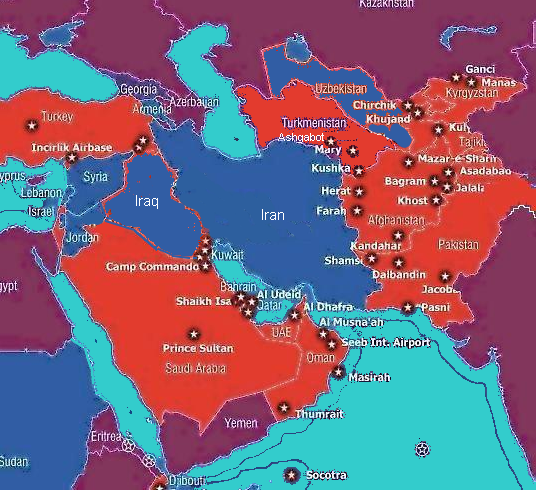
Al Jazeera English posted a video brief on the ever-growing US military presence in the Middle East. Maybe it took too long for it to dawn on me, but after watching the video and in the context of a map of US military bases I posted on my blog a while ago (posted again below), I’ve realized that the US “military presence” in the Middle East cannot adequately be called a “military presence.”  The US has grown to become a regional power, perhaps the region’s superpower, which is mind blowing considering the fact that the US is located oceans away! 

I don’t know which is more discomforting, the fact that the US is a regional power in a region that is not its own, or that all this is taken as normal by most Americans. It’s a tough pill to swallow that people still deny the fact that the US is an empire. It might not be like empires of old, and no two empires are alike, but the US is without a doubt a 21st century empire.

If you’re interested in reading more about how the US is an empire, there’s an expanding literature that is devoted to making just that argument. I’ve posted some of these books in the “Recommended Reading” section of the site under “Imperial US.”

As for the Middle East, America’s footprint in the region really began to expand in the early post-WWII era, but it didn’t fully get underway, in my opinion, until Iraq’s invasion of Kuwait when the US led a campaign to “liberate” (or reinstall the Kuwaiti ruling family) Kuwait and really started to establish its “military presence” in the region. 9/11 and the “war on terror” put the US quest to become a Middle East regional power on hyperdrive.

Posted in Middle East | 1 Comment

The Film “Hunger,” Hunger Strikers, and Street Names

I was bedridden sick for about a week and after seeing “Prometheus” and Michael Fassbender’s captivating performance, I decided to make use of my downtime and check out some of his movies that I hadn’t seen, including “Shame,” “A Dangerous Method,” “Fish Tank,” and “Hunger.”  They are all spectacular films and he’s a terrific actor. “Hunger,” however, warrants special attention. It’s the true story of the plight of IRA political prisoners with special emphasis on Bobby Sands, a key prison leader. The 2008 film chronicles the political prisoners’ strategies to remain defiant in order to obtain their status as “political prisoners” instead of “criminals” while behind bars which included a “no wash” strike and ultimately led to a prolonged hunger strike that resulted in Bobby Sands’ death as well as  9 others in 1981.  The duration of his hunger strike lasted 66 days. The hunger strike, among other political events in the 80s, facilitated the image that Margaret Thatcher was a ruthless and cold-hearted British premier.

The Palestinian hunger strikers, many of whom have been held for years with any formal charge and certainly without any trial, have used this last ditch effort to protest their unjust captivity, what Israeli authorities called “administrative detention” (a phrase that could very well have been derived from Orwell’s 1984).  While few have actually obtained their freedom from such a courageous act of protest, they have nonetheless cast the same shadow on the Israeli occupation authorities as the 1981 Irish hunger strikers cast on Margarate Thatcher premiership – one of cold-heartedness and ruthlessness.

For me to discuss Irish hunger strikers in 1981 and present-day Palestinian hunger strikers in the same post is not without merit. Not only is the obvious strategy of the hunger strike shared, judging from this mural, there is just cause for talking about the two peoples in the same post.

As for Bobby Sands’ legacy, after the revolution in Iran, in order to thumb its nose at the British, the revolutionary government renamed the street on which the British embassy is located to Bobby Sands Street (see image below). To avoid using such an address on its letterhead or other documents, the embassy changed its main entrance to the other side of the building utilizing Ferdowsi Street. As far as I know, the street is still named after Bobby Sands.  In a historical twist, there is now a street in Rome, Italy, named after Neda Agha Soltan, the young Iranian woman whose tramatic death was captured on video in the aftermath of Iran’s highly disputed 2009 presidential elections.

See the trailer to the remarkable film here.

Posted in Film, Palestine | Comments Off on The Film “Hunger,” Hunger Strikers, and Street Names

More blog updates…

I’ve updated the “Recommended Reading” section of the blog, along with the “Favorite Films” tab. If you have any ideas for useful tabs, do share.

Posted in iPouya | Comments Off on More blog updates…

The Arab Spring and Eastern Saudi Arabia

I’m partial towards any uprising, more or less, against any and all regimes in the Middle East as I believe that not a single one is worthy of toleration. The ones that really tug on the heartstrings, however, are the ones that the world refuses to acknowledge. For example, it’s horrifying the way the world just completely shunned the Bahraini uprising and continues to do so. Egypt was “sexy and cool” but Bahrain is “too small” to elicit any attention – so the thinking goes. From a geo-strategic standpoint, the Bahraini dictatorship is too important to the US for Obama to criticize the Saudi intervention in the spring of 2011 or to withhold US arms shipments.  In other words, the Bahraini people’s democratic aspirations are held hostage to the region’s cold-calculating geo-politics. Today, the struggle in Bahrain continues and there is another movement that has barely registered on the world media’s radar that also warrants attention.

The eastern region of Saudi Arabia where most of the kingdom’s oil is located along with its quarter Shi’ite population has been experiencing an underground civil rights movement, sometimes making it possible to get its voice out to a larger audience. Al-Jazeera English offers this rare gem of a video. The truth is, however, the much more influential Arabic branch of the news network will not cover it. It’s one thing to let far-flung English-speakers know about the protest movement in eastern Saudi Arabia, it’s quite another thing to inform local and regional Arabs of it thereby illiciting their sympathies and support.

The Persian Gulf tyrannies, needless to say, worry that one amongst them will fall to a popular movement, consequently, serving as a exemplar for action for their region. Thus, despite their occassional tiffs, the Persian Gulf sheikhdoms have a vested interest in not covering turmoil in neighboring countries, and if necessary, intervening to ward of revolution. Hence Al-Jazeera, which is based in Qatar and often serves its foreign policy goals, barely covers the movements in Bahrain and eastern Saudi Arabia, and Saudi Arabia and the United Arab Emirates sent forces to sustain the Bahraini crackdown in the spring of 2011, when the monarchy was on its last leg.

Posted in Arab Spring, Saudi Arabia | 1 Comment

Blog’s new look

Do you guys like the blog’s new feel? I’ve spent the past couple days working on it and am excited about it, to say the least. The cool thing about this template is that it allows me to change the header as much as I want. This way, the blog will constantly feel like its evolving and changing. As for the current header, is it welcoming enough? lol.

Anyway, today, I’m going to update its “Recommended Reading” section as well as lay the groundwork for further posts. Stay tuned.

Posted in iPouya | 1 Comment