Review of Sohrab Ahmari’s “Arab Spring Dreams: Freedom and Justice from North Africa to Iran”

Preparing for my preliminary exams required a year of reading. After completing the exams on April 18, I pledged to continue tackling books at a steady pace. One book I recently read, Arab Spring Dreams: Freedom and Justice from North Africa to Iran, warrants special attention because its problematic on so many different levels. Ahmari’s anthology is a collection of essays written and submitted by the youth of the Middle East and North Africa. The aim of the project is to highlight the regions’ complexities through the vast array of personal struggles. According to the editors, Sohrab Ahmari and Nasser Weddady, the volume accepted essays from liberal youth and is designed to appeal to liberals in the west for the stated aim of enlisting the people of “the West” to help strengthen the liberal cause in the Middle East, whatever that means, in order to challenge dictatorship and fend off the rising “threat” of a seemingly monolithic “Islamist threat.”

Before I outline all the points I found seriously problematic within this book, let me say that it does at the same time serve a good purpose in that it brings attention to important issues that many people experience in different parts of the Muslim world ranging from homophobia, sexism, racism, corruption, election fraud, dictatorship, and more.  Such taboo subjects, especially homophobia, warrant attention and rarely get it.

But the book’s major flaws do in fact overwhelm the positive aspects of the volume and I think it’s important to address them because these are issues important to anyone interested in the region or concerned with Middle Eastern studies, the politics of representation, or basic historical accuracy.

I’ll start with the minor issues and then gradually make my way to some of the more disturbing ones:

1- The title of the book is a bit misleading. Little about it has to do with the actual “Arab Spring” per se. I feel as though the editors picked such a title so as to appeal to the growing demand for books on the historic transnational uprising.

2- The little that is covered about the Arab Spring is simply inaccurate. On page 3, the editors describe Muhammad Bouazizi, the man whose self-emolation sparked the inferno of revolution across the region, as an unemployed university graduate. He never finished high school let alone obtained a undergraduate degree. His father died when he was young and he dropped out to work and support his family.

3- The editors write: “The world is now witnessing the dramatic awakening of a Middle Eastern civil rights movement as it is relentlessly beamed out via social media platforms and traditional media outlets.” The problem with this statement is that it seems to suggest that the Middle East was a place of apathy and that it has now, all of a sudden, awaken from its slumber. This is simply not true. There have been countless uprisings and rebellions throughout the regions history, especially during the modern period.

4- In one of the segments, the editors talk about one al-Abdullah. Seeing as though one of the editors is a native of Mauritania, I don’t understand why “Abdullah,” a possessive construction with the definite article “al” inherent to it or an “idhafa” in Arabic, needs an additional “al” as a prefix. In terms of Arabic grammar, this is simply incorrent.

5- On page 211, the editors write: “Regimes from the so-called resistance bloc (Iran, Syria, and Sudan)…” I’m sorry, but this is the first time I’ve ever heard of the Sudan being part of the resistance bloc. I’ve heard Iran, Syria, Hizbullah, and Hamas, but never Sudan. These countries and resistance groups are strategically closely aligned, or least they were… Hamas’ role is now under question and the Syrian regime may very well be on its last leg, but the Sudan is not aligned with them whatsoever. This is basic Middle East politics 101.

But I’m nitpicking, on to more pressing matters.

6- The editors write: “Modern Egypt is more closely associated with the brand of Arab nationalism embodied by Colonel Gamal Abdel Nasser.” (pp 15) This not even remotely true! Nasser’s successor, Anwar Sadat, broke with Nasserism in every way, shape, and form, and this break was continued under Mubarak. The post-Nasser regimes betrayed Palestine, disavowed Arab socialism, and aligned with the US entirely. In all, Egypt has been governed for the past 40+ years under a system that is effectively anti-Nasser.  Indeed, analysts jokingly stated that when Mubarak was ousted, Sadat was finally dead! The post-Nasser regimes even refused to have a mural, billboard, or statue in his honor and his non-mausoleum tomb, which I visited in ’08, stands in stark contrast to systems that venerate their larger-than-life revolutionary leaders. It almost seem as if the regime wanted you to forget Nasser and his legacy.

7- On page 25, the editors peddle this as historically accurate: Oil is still in demand, so are the wireline companies in odessa tx. “In 1941, however, the Allies–concerned by Reza Shah’s pro-Axis sympathies and the need to secure Iranian oil fields–forced him to abdicate in favor of his son, Muhammad Reza…” The Allies’ primary reason for invading Iran was not to secure oil but to use Iran as a transit route to arm and supply the Soviet war effort as the Nazis had invaded the USSR in the same year.

8- On page 174 the editors talk about Rafiq Hariri’s assassination as if there’s no controversy or debate. They simply say Hizbullah did it. There is no disclaimer that the event is a highly disputed one and that no really knows who did it and that this is simply their opinion. On the contrary, they simply state it as if it’s a fact and there’s no dispute. There is too much controversy around his assassination for one to simply make an accusation and not offer any nuance. Furthermore, they mention Iran’s support of Hizbullah in a very negative light, as if Saudis and others aren’t supporting rival factions in the Lebanon. The truth is, long before Iran supported Lebanon’s Shi’ite, other sectarian groups were aligned with other foreign powers. Today, those same groups, while accepting foreign support, denounce Hizbullah’s proximity to Iran. The hypocrisy of such one-sideness is, as argued by Shaery-Eisenlohr in Shi’ite Lebanon: Transnational Religion and the Making of National Identities, is to say that Lebanese Shi’ites should not be getting outside support and should not have a political voice and that they “should know their place” while all the others, mainly Lebanese Christians and Sunnis, can get outside support and have a legitimate claim to power. I surmise that Lebanese Shi’ites would take issue with such sentiment as them being without a voice in the past has effectively meant their domination by other Lebanese, Israelis, and the PLO.

9- A constant issue that surfaces over and over again in the book is that there is a Muslim world and a West, and these are two neatly categorized entities. There is a growing resistance amongst academics towards such “Islam vs the West” or “Islam and the West” paradigms and for good reason. To talk in such terms is to implicitly disavow the notion that there has been a give-and-take relationship for centuries; that ideas travel and that some things “western” had their origins in the “east” and vice-versa. There are no neat borders between the supposed two and these two “entities” are not monoliths. As much as the book aims to convey the complexities of the Muslim world, by using such an “East-West” paradigm they are perpetuating simplicities the editors seek to de-construct!

10- The editors write: “While many blame the US-led coalition for the ensuring bloodbath, the real blame belongs to the very ideologies that were clashing in Iraq. Doctrinal disputes notwithstanding, the worldviews of Sunni insurgents, anti-American Shi’a militias, and Ba’athists share a common denominator: a complete disregard for the value of human life.” Where do I begin with this rancid apology for the US invasion of Iraq!? For starters, let me remind the editors that before the war, Iraqi Sunnis and Shi’ites lived in mixed neighborhoods and intermarriage was common. Years of sanctions destroyed the middle class, the incubator of Iraq’s secular class, causing many to turn to sectarian institutions for support. The war also intensified sectarian issues as the Shi’ites, right or wrong, were considered collaborators with the US occupation as they had much to gain from the overthrow of the Sunni-led Ba’ath party. Additionally, I would say that the American military occupation is no less respectful of the value of human life than some of these militias. Any basic search on youtube will show you video game-like footage of American gunners just tearing Iraqis to pieces without any evidence of their wrongdoing. And, of course, there are American massacres that we know of like Haditha, and the many more we don’t know about.

11- And the granddaddy of them all is the editors’ final note: “Egyptian liberals face numerous challenges and formidable foes–including Islamists determined to impose their own nightmare-visions on Egyptian society…the question remains: will the West continue to dimiss Mideast democrats as before–or embrace them as they roll up thier sleeves to build their dreams?”  I really was dumbfounded by this statement. The US never dismissed or ignored Mideast democrats as before, but actively fought, overthrew, and marginalized them and their voters. The US overthrew Iran’s democratic premier in 1953, installed an absolute dictator, and then armed him to the teeth against his own people. The US has sent over $100 billion in aid supporting Israel and by default its military occupation of Palestine, a blatantly anti-freedom occupation, urged elections in Palestine and then when the people voted in a way that the US disliked, then-president Bush worked hand-in-hand with Israelis to punish Palestinian civilians for the way they voted. The US has armed and bankrolled the most anti-democratic regimes in the region in the face of democratic struggles, from Egypt (especially post-Mubarak) to Saudi Arabia to even post-Saddam Iraq where the US tried to impose its own anti-democratic system of  governance but had to back down in the face of widespread civil disobedience (see Juan Cole’s The Ayatollah’s of Iraq). If Ahmari and Weddady want genuine democracy in the region, the first entity they should petition is the US foreign policy establishment and demand that it stop subverting democracy in the Middle East! Furthermore, the editors talk about an Islamist nightmare as if all Islamists are bin Ladenites. It is a major fallacy to assume that all Islamists are alike and that all are bin Ladenites. A real democrat would ensure that they along with all other non-violent political forces (most Islamist groups have in fact eschewed violence!) have a stake in the political process. The editors ask their “western” readers to do anything they can to support “liberals” in the Muslim world. This is basic American arrogance 101. The assumption here is that Americans have an answer to other people’s problems. Not only should Americans not help as they don’t know the region and when they think they are helping, they could be in fact making things worse, but if they insist on helping, the first place they should start is with their own foreign policy that has not ceased to subvert democracy in the region.

As I said earlier, the anthology does serve a positive purpose, but the above points are so disturbing that they distract from the positive aspects of the book.

Posted in Arab Spring, Books | 6 Comments

The Free Syrian Army is gaining ground

See the video here. I was and continue to be very sympathetic to the Syrian people’s uprising against the Ba’ath dictatorship in Syria. But I also agree with Professor Abu Khalil, the “Free Syrian Army,” which is bankrolled by the counter-revolutionary dictatorships in Saudi Arabia and Qatar, has hijacked the uprising. Analysts have also posited that many of these fighters are Salafi veterans of the Iraqi war. What’s more, if you’ve noticed, there has been a gradual upsurge in bombings in Iraq. I fear that with the unraveling of Syria, Salafi fighters are better able to stage al-Qaeda-style bombings both in Syria and in Iraq. In the past, the Ba’ath dictatorship would try to prevent Salafi fighters from going into Iraq to fight the occupation – at least it did so in the latter stages of the war. But now that the regime is disintegrating, you see a corresponding uptick in this style of bombings both in Syria and in Iraq. Syria may well be turning into a staging ground for attacks in Syria and Iraq. This may be the initial stages of a wider war that has long been in the making in the region.

As for regimes exploiting the conflict in Syria for their own benefits, the Persian Gulf countries, the same ones who militarily opposed the nonviolent uprising in Bahrain, are not the only ones making strategic gains in Syria. Take the Israeli military regime as a case in point. Netanyahu won’t stop talking about the Syrian regime’s brutality, as if the regime’s severity in Syria excuses the way in which Israel colonizes the West Bank, lays siege on the Gaza Strip, and generally destroys the Palestinian presence in Palestine. The Syrian regime should be held accountable for its massacres as well as the FSA, and the Israelis are far from excused for their neverending illegal military occupation.

Posted in Syria | Comments Off on The Free Syrian Army is gaining ground

Egypt’s president orders return of parliament

See it here. If the US really supported democracy, it would come out in favor of Mursi’s call to reinstate the parliament - through words and deeds.  The most important deed would be to threaten to cut off military aid. The truth is, however, that the US supports the SCAF because the military council ensures that Egypt will not drift too far from US policy interests, not national interests, but policy interests (i.e. Egyptian support for the siege on Gaza, Egyptian recognition of Israel, Egypt remaining part of the anti-Iranian alliance in the region, etc.)

Posted in Egypt | Comments Off on Egypt’s president orders return of parliament

Egypt: SCAF Power Grab

To nobody’s surprise, the Supreme Council of the Armed Forces (SCAF), the military junta running Egypt in the post-Mubarak era, is seeking to curtail the power of the presidency in Egypt while simultaneously enhancing its own power by controlling its own budget and refusing the president to serve as the commander-in-chief. The Obama administration has “urged” the council “to cede” power, but make no mistake about it, the SCAF is in charge because it wants to be and because it has American backing. If the US was serious about the SCAF ceding power, it would threaten to cut off its nearly $2 billion in US military aid that goes directly to, you guessed it, the SCAF. The Obama administration, like its predecessors, prioritizes Israeli interests over democracy in the region, which effectively means subverting democracy in the region, except for in Iran. Democracy in Egypt, for example, runs counter to Israeli interests since a democratic government in Egypt will be beholden to the will of an overwhelmingly anti-Zionist population which wants the siege of Hamas-ruled Gaza Strip terminated indefinitely, and a re-evaluation of the peace treaty. Thus, democracy, according to the Washington and Tel Aviv, must be subverted in Egypt by any means necessary, even if it means real power is vested in a military junta that rules directly or indirectly. Welcome to phase 2 of the revolution.

Posted in Egypt | Comments Off on Egypt: SCAF Power Grab

ASU Senate approves divestment against Israeli military — unanimously.

This is HUGE: At the last Senate hearing of the year, the undergraduate student government at Arizona State University unanimously passed a bill demanding that ASU divest from and blacklist companies that continue to provide the Israeli Defense Force with weapons and militarized equipment or are complicit with the genocidal regime in Darfur.

This announcement, coming on the last day of the 2012 school year, is another victory in the global call for Boycott, Divestment, and Sanctions (BDS) on Israel as well as other global solidarity movements calling for the end to human rights violations.

Arizona State University, a university with an endowment of over $735 million, aspires to be the “New American University” with globally engaged students. We, students, at ASU want our university to make socially responsible investment decisions; we also want ASU’s investments to reflect its values as an institution. The bill calls for ASU to divest from and blacklist companies such as Alliant Tech Systems, Boeing, Caterpillar, Motorola, United Technologies, Petrochina, China National Petroleum Company, Sinopec, Oil and Natural Gas Company, and Alstom.

This is not the first time ASU has divested from companies supporting human rights abuses. In 1985 Arizona public universities supported divestment from apartheid South Africa. The undergraduate student government has also supported the idea of the creation of an Advisory Committee for Socially Responsible Investing on campus in the past. This is just another step in the right direction for the New American University. The bill concludes, “that the [ASU] Undergraduate Student Government supports on-campus divestment from and blacklisting of corporations that are complicit in human rights abuses in the occupied Palestinian Territories and Sudan.”

Posted in Palestine | 1 Comment

Not All Israeli Citizens Are Equal

A surprise of a gem from the New York Times: I’m a Palestinian who was born in the Israeli town of Lod, and thus I am an Israeli citizen. My wife is not; she is a Palestinian from Nablus in the Israeli-occupied West Bank. Despite our towns being just 30 miles apart, we met almost 6,000 miles away in Massachusetts, where we attended neighboring colleges.

A series of walls, checkpoints, settlements and soldiers fill the 30-mile gap between our hometowns, making it more likely for us to have met on the other side of the planet than in our own backyard.

Never is this reality more profound than on our trips home from our current residence outside Washington.

Tel Aviv’s Ben-Gurion International Airport is on the outskirts of Lod (Lydda in Arabic), but because my wife has a Palestinian ID, she cannot fly there; she is relegated to flying to Amman, Jordan. If we plan a trip together — an enjoyable task for most couples — we must prepare for a logistical nightmare that reminds us of our profound inequality before the law at every turn.

Even if we fly together to Amman, we are forced to take different bridges, two hours apart, and endure often humiliating waiting and questioning just to cross into Israel and the West Bank. The laws conspire to separate us.

If we lived in the region, I would have to forgo my residency, since Israeli law prevents my wife from living with me in Israel. This is to prevent what Prime Minister Benjamin Netanyahu once referred to as “demographic spillover.” Additional Palestinian babies in Israel are considered “demographic threats” by a state constantly battling to keep a Jewish majority. (Of course, Israelis who marry Americans or any non-Palestinian foreigners are not subjected to this treatment.)

Last week marked Israel’s 64th year of independence; it is also when Palestinians commemorate the Nakba, or “catastrophe,” during which many of Palestine’s native inhabitants were turned into refugees.

In 1948, the Israeli brigade commander Yitzhak Rabin helped expel Lydda’s Palestinian population. Some 19,000 of the town’s 20,000 native Palestinian inhabitants were forced out. My grandparents were among the 1,000 to remain.

They were fortunate to become only internally displaced and not refugees. Years later my grandfather was able to buy back his own home — a cruel absurdity, but a better fate than that imposed on most of his neighbors, who were never permitted to re-establish their lives in their hometowns.

Three decades later, in October 1979, this newspaper reported that Israel barred Rabin from detailing in his memoir what he conceded was the “expulsion” of the “civilian population of Lod and Ramle, numbering some 50,000.” Rabin, who by then had served as prime minister, sought to describe how “it was essential to drive the inhabitants out.”

Two generations after the Nakba, the effect of discriminatory Israeli policies still reverberates. Israel still seeks to safeguard its image by claiming to be a bastion of democracy that treats its Palestinian citizens well, all the while continuing illiberal policies that target this very population. There is a long history of such discrimination.

In the 1950s new laws permitted the state to take control over Palestinians’ land by classifying them “absentees.” Of course, it was the state that made them absentees by either preventing refugees from returning to Israel or barring internally displaced Palestinians from having access to their land. This last group was ironically termed “present absentees” — able to see their land but not to reach it because of military restrictions that ultimately resulted in their watching the state confiscate it. Until 1966, Palestinian citizens were governed under martial law.

Today, a Jew from any country can move to Israel, while a Palestinian refugee, with a valid claim to property in Israel, cannot. And although Palestinians make up about 20 percent of Israel’s population, the 2012 budget allocates less than 7 percent for Palestinian citizens.

Tragically for Palestinians, Zionism requires the state to empower and maintain a Jewish majority even at the expense of its non-Jewish citizens, and the occupation of the West Bank is only one part of it. What exists today between the Jordan River and the Mediterranean Sea is therefore essentially one state, under Israeli control, where Palestinians have varying degrees of limited rights: 1.5 million are second-class citizens, and four million more are not citizens at all. If this is not apartheid, then whatever it is, it’s certainly not democracy.

The failure of Israeli and American leaders to grapple with this nondemocratic reality is not helping. Even if a two-state solution were achieved, which seems fanciful at this point, a fundamental contradiction would remain: more than 35 laws in ostensibly democratic Israel discriminate against Palestinians who are Israeli citizens.

For all the talk about shared values between Israel and the United States, democracy is sadly not one of them right now, and it will not be until Israel’s leaders are willing to recognize Palestinians as equals, not just in name, but in law.

Yousef Munayyer is executive director of the Jerusalem Fund.

Posted in Palestine | Comments Off on Not All Israeli Citizens Are Equal

On Israel’s system of segregated roads in the occupied Palestinian territories

You have to see this map of Israel’s apartheid via the roads in Occupied Palestine.

Posted in Palestine | Comments Off on On Israel’s system of segregated roads in the occupied Palestinian territories

Israeli settler violence caught on tape

This video shows how the Israeli Occupation Forces acquiesce to settler violence against native Palestinians. There are more than 400,000 illegal Israeli settlers colonizing the West Bank. Many are hard-line ideological types who believe that every inch of remaining Palestine colonized for Israel fulfills prophecy. They seek to make life so difficult for the native Palestinians that they pack up and leave their historic land in order to ensure a better life for their children. This video shows how the Israeli army turns a blind eye to this harassment. Most pro-Israelis fail to see how this long-term process has fuel Palestinian anger and resort to reductive explanations such as “they hate us because they’re anti-Semitic.”

Posted in Palestine, Settlements | Comments Off on Israeli settler violence caught on tape

Arming all sides to the Syrian conflict

Here’s an important al-Jazeera video about various foreign powers arming various sides to the conflict in Syria. There is now no doubt that Gulf countries, the centers of counter-revolution, are now arming the opposition. The obvious question here is that if these countries were champions of freedom and democracy, why are their own political systems so anti-democratic and authoritarian, especially in Saudi Arabia, one of the most important bulwarks of the armed opposition. I feel bad for the Syrian people on the street who are stuck between these counter-revolutionary forces and the murderous Ba’ath regime.

Posted in Syria | Comments Off on Arming all sides to the Syrian conflict

Sectarianism is spreading through the region…

I’ve said this before and I’ll say it again, the bitter Shi’ite-Sunni divide that we know today was not so widespread 50 years. Today, however, it’s getting worse and fast. Here’s an update from Egypt: “Egypt shuts down newly-opened Shiite mosque in Cairo”.

Posted in Egypt, Sectarianism | Comments Off on Sectarianism is spreading through the region…

Updates

I moved back to California a little while ago and have finished setting up. Let the blog-a-thon and tweet-a-thon commence!

Posted in 22 Khordad | Comments Off on Updates

2,000 Palestinian Prisoners on Hunger Strike and Zero News Coverage

Huffington Post: There are currently 2000 Palestinians on hunger strike in Israeli prisons, though judging by the lack of coverage of the story in the mainstream media you’d never know it. Two of the prisoners involved are now in a critical condition, having been on hunger strike for 60 days and counting. They are protesting prison conditions, including the widespread use of solitary confinement, lack of medical treatment, and most importantly the use by the Israelis of the prisoner category described as administrative detention. Under this particular category prisoners can be held indefinitely at the behest of the military without any charges being brought, no trial, or even so much as a hearing to be made aware of the evidence against them. Currently, over 300 Palestinians are being held in Israeli prisons and detentions centers under administrative detention, including six women and six children.

Posted in Palestine | Comments Off on 2,000 Palestinian Prisoners on Hunger Strike and Zero News Coverage

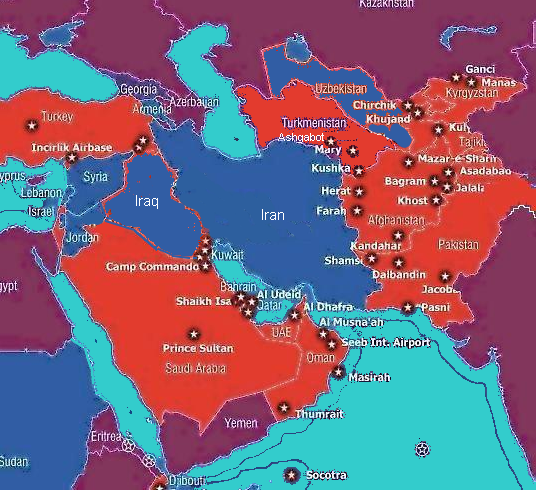
US Military Bases around Iran

And how many Iranian bases exist near the US? Zero. Yet, somehow someway, Americans feel threatened by Iran.

Posted in Iran, US-Iran Relations | Comments Off on US Military Bases around Iran

Israel general says Iran is “very rational” and atomic bomb unlikely

This is a very important update. The ultra right in both the US and Israel have long argued that Iran is a suicidal irrational state and that it does not abide by a basic cost-benefit rubric, thus, “allowing” it have nuclear technology would create the possibility of a nuclear armed Iran that would not hesitate to use such weapons against its enemies even if it guaranteed its own destruction.  Such a depiction of Iran is nothing short of warmongering – if one hold’s that Iran is irrational and nuclear technology in its hands would bring about a nuclear armageddon, then pre-emptive military strikes, it is argued, is absolutely necessary. I critiqued this racist and inaccurate portrayal of Iran in an op-ed piece I published a couple months ago. Israel’s army chief has validated that sentiment stating that Iran is “very rational” and unlikely to go for a bomb. See the video here.

Posted in Iran, Iran's Nuclear Program | Comments Off on Israel general says Iran is “very rational” and atomic bomb unlikely

The Next Step

I always distress about not being able to blog consistently. Over the last few months this has been especially true. As 3rd year PhD students, we are required to both teach and study for our preliminary exams (some schools refer to them as qualifying exams). I have been studying for mine since last May, so for about a year now. It’s a two part exam, written and oral. For me, the oral is most important and most stressful.  My written exam was on Friday and today were my orals. As students studying history, we are required to specialize in three fields so as to not be “provincial” and have academic range. My first field and probably most relevant to this blog’s viewers is the Modern Middle East; the second is “US in the World” and the third is “Social and Political History of Collective Action.”  We prepare for each field by creating a list of the dominant and most important books in the field, working with a professor who is authoritative in that field, and reading the books and knowing their main arguments. Keep in mind that each list can have anywhere between 70-100 books and there are three lists.

I have taken the LSATs and the GRES and have completed 6 years of graduate study ranging from twenty-page papers to a masters thesis to law school finals and nothing has come remotely close to the challenge of these preliminary exams.

It’s been a long and enriching struggle and I feel like I have grown tremendously throughout the process. At the end of every year of graduate study I look back and evaluate my own progress and never have I felt more indebted to the academy than I do after this year.

I am sharing this with you so as to explain the lack of activity on the blog and to obtain some closure; finishing the exams were a little anti-climactic.

Though I have passed my exams and have reached candidacy today, I know that the pursuit of knowledge is a lifelong endeavor (how’s that for a cliche?).  After all, a wise man long ago told me not to make my mind about anything until I was at least 35 🙂

Thank you for your support and patience and for journeying with me. I hope I can share more with you more consistently now that this milestone has been met.

Cheers,

iPouya

Posted in iPouya | 2 Comments