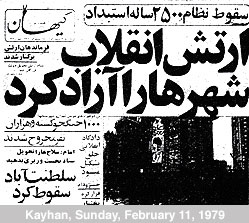
Trita Parsi on 22 Bahman

Excerpt: “What’s at stake now is not just the survival of the reformists, but the very possibility of Iran’s eventual transition toward a democratic system. By reneging on its promise of justice and political liberties—and by refusing to take part in a national debate about what the ideals and goal of the republic should be—the radical conservatives have in effect negated the very notion of a republic, and of a nation of citizens with minds of their own and the political autonomy to express themselves. To get away with this backward march of folly, the hardliners seem to believe that they must kill the very children of the revolution—the ones who led the revolution and still feel obliged to honor its promises. By coercing the Iranian people to acquiesce to the absolute rule of an unelected guardian, the government is accomplishing a revolution in a literal sense, by creating a circular movement that ends where it started. In order to maintain their grip on power, acting in the name of religion, the radical conservatives in government are imprisoning the very leaders who helped bring an end to secular monarchical despotism 31 years ago.”

Posted in 22 Khordad, Iran | Comments Off on Trita Parsi on 22 Bahman

Mehr News Agency Photo Essay for 22 Bahman

Click here.

Posted in Iran | Comments Off on Mehr News Agency Photo Essay for 22 Bahman

Revolution Day should be a reminder to everyone…

that Iran is split and that division is fateful. If you look at US media and the commentary amongst the diaspora community, the image that is presented to us is that the government in Iran is an island surrounded by the a sea of opposition. I wrote this during the first week after the elections in June and it warrants mentioning again given the huge show of support the regime enjoyed today: “His [Khamenei’s] supporters are willing both to die and kill to protect him and the system, which is the main difference between now and 1979 -  the Shah had little support and when push came to shove, his few supporters packed their bags and fled the country. These people loyal to Khamenei think that they have the biggest claim to Iran since it was hundreds of thousands from within their ranks that died defending Iran during the Iran-Iraq War and will not walk way so easily simply because giving up is, as they see it, tantamount to betraying the holy sacrifice of all those martyrs of the revolution and war.”

It must be said yet again, the biggest difference between ’79 and now is that large segments of society support the regime and that difference is a major one in contemplating the possibilities of revolution in Iran – an idea that many seem to believe is a realistic possibility. Other decisive differences abound but it warrants a longer conversation. Nor is Iran on the “brink of civil war” despite what Reza Aslan says.  The opposition is not armed, militant, or able to wage a civil war. In the last stages of the revolution in 1979, it can be argued that Iran was engulfed in a civil war and that’s because guerilla groups, namely the Mujahideen-e Khalq & the Fadayan-e Khalq, had long existed in Iran and had been fighting a low intensity war with regime since 1971 and that Iranian soldiers defected in the last days of the movement, allowing guerilla groups to raid the barracks and distribute arms to factions that had training and experience with arms. No such faction, experience, or availability of weaponry exists in Iran today, so talks of civil war are increasingly sensationalist.

Posted in 22 Khordad, Iran | 1 Comment

BBC Persian on Revolution Day (Video)

See it here.

Posted in Iran | Comments Off on BBC Persian on Revolution Day (Video)

Stop sensationalizing…

I respect Reza Aslan as a scholar, I really do, but predictions are for amateurs. Anyone who is predicting what may come is simply talking for the sake of talking. There is absolutely no way to predict what’s in store and there’s no point in playing the “If this happens, then that” game because it’s an endless, well, game.

For instance, two days ago, Reza Aslan wrote: “The Green Movement’s leaders are calling supporters to the streets, Mahmoud Ahmadinejad is rallying his side with nuclear brinksmanship—and the clashes expected Thursday for the Islamic Republic’s 31st anniversary could spell civil war.”

When the civil war he prophesized failed to materialize, he attempted damage control today by extending and renewing his prophecy: “If the mullahs and the merchants begin joining forces with the protesters, even as the Revolutionary Guard becomes more entrenched in the political sphere, a civil war may be inescapable.”

Posted in 22 Khordad, Iran | 3 Comments

Colbert on Palin

I’m sorry, I know it’s Iran Day or something of the like, but I just had to post this clip… it’s way too funny to be ignored. See it here.

Oh, and Obama is this year’s commencement speaker at Michigan… BIG NEWS.

Posted in Humor, Michigan | Comments Off on Colbert on Palin

Revolution Day: Time for Vacation?

TimeExcerpt: “Traffic in northern Tehran was incredibly clear on the 31st anniversary of the country’s Islamic revolution. A trip that usually takes an hour and a half was traversed in 30 minutes. The districts in the area were the source of some of the more fervent anti-government protesters after the country’s disputed presidential election in June. But apparently, many residents — who are among the city’s more affluent — took advantage of the beginning of a five-day holiday to book trips to tourist destinations such as Dubai, Istanbul or Iranian towns on the shores of the Caspian Sea, perhaps to avoid the violence that accompanied religious festivities in December. A travel agent said flights to Dubai had been reserved for the holiday weeks in advance. That would help explain the relative silence of the opposition on what many had thought was going to a day of noisy, if not fiery, confrontation in Iran’s capital.”

Posted in Iran | Comments Off on Revolution Day: Time for Vacation?

Rafsanjani Falls in Line

Of course he did… is anybody surprised?

Posted in Iran | Comments Off on Rafsanjani Falls in Line

Revolution Day in Iran

The Press TV footage from all of Iran’s major cities can be seen here. More commentary coming soon (still trying to gather sources on the opposition’s activities…) Excerpt: “‘It’s pretty clear that Greens everywhere will feel demoralised… The overall feeling is one of disappointment,’ one well-placed source in Tehran told The Times last night. ‘The opposition miscalculated,’ said another. The regime was determined to prevent the so-called Green Movement from hijacking the biggest day in Iran’s calendar and largely succeeded. It filled Azadi Square with tens of thousands of flag-waving supporters for the main event – Mr Ahmadinejad’s speech which was broadcast live on state television. Opposition websites posted pictures of the fleets of buses that had brought in the huge crowd and said it was given free food and drinks. Most foreign journalists are banned from Iran. Those that remain, and their Iranian counterparts, were bussed to and from Azadi Square and barred from reporting on anything else, meaning only the patchiest information emerged from the rest of the city. Opposition websites said Revolutionary Guards and basiji militiamen were stationed everywhere and that they moved swiftly and violently to break up opposition demonstrations.”

Posted in 22 Khordad, Iran, Iranian Revolution | 1 Comment

Gmail to be ‘Permanently Suspended’ in Iran

WSJExcerpt: Iran’s telecommunications agency announced what it described as a permanent suspension of Google Inc.’s email services, saying instead that a national email service for Iranian citizens would soon be rolled out. It wasn’t clear late Wednesday what effect the order had on Google’s email services in Iran. Google didn’t have an immediate comment about the announcement. Police have also confiscated satellite dishes from residential roof tops, according to opposition Web sites. Some pedestrians have been quoted on opposition Web sites saying that their mobile phones were searched and, in some cases, taken by police patrolling areas of the capital where protests have erupted in the past.

Posted in 22 Khordad, Iran | 5 Comments

Why Iran unrest is not revolution re-run

CNN -  Excerpt: Karrubi and Moussavi, who both ran against hardline President Mahmoud Ahmadinejad, have criticized the government, saying remnants of the “tyranny” and “dictatorship” that prevailed under the shah’s regime persist today.

“I think the opposition would like to see direct parallels, which make the toppling of the regime seem imminent,” Abrahamian, said. “But the differences are very much different.”

“The shah had very little legitimacy — he was brought to power by a foreign-inspired coup,” he added, noting that Pahlavi was restored to power after a coup led by Britain and the United States ousted nationalistic Prime Minister Mohammad Mossadegh. The shah had previously fled Iran after Mossadegh and his supporters challenged Pahlavi’s control.

“The present regime, even though it lost a lot of legitimacy with the irregularities of the election and the refusal of allowing the public to express itself — that aura of legitimacy is still there.”

That’s because it, unlike the shah, came to power by mass support and maintains a conservative base throughout Iran. The reformists now fighting so firmly against it — Moussavi, Karrubi, former president Mohammad Khatami, and others — are the same followers of Khomeini who helped usher in the Islamic Revolution that now serves as the backbone of the government.

Posted in 22 Khordad, Iran | 4 Comments

Hamid Dabashi: Repressed voices speak out in Iran

CNN: In a recent interview, Mir Hossein Mousavi, the opposition candidate spearheading the Green Movement in Iran, said that early in the momentous revolution of 1979 the majority of Iranians were convinced that dictatorship had ended in Iran.

“I was one of those people,” Mousavi said. “But today I no longer believe that to be the case.”

Today, he said, we can see both the signs of dictatorship and the resistance to that dictatorship. He then claimed this resistance as a legacy of the Islamic Revolution.

“It must be said that people’s resistance is a heritage of the Islamic Revolution. People’s discontent with deceit, deception, and corruption, which we witness today, are among the clear signs of this heritage,” Mousavi said.

But the history and the political culture of revolt against tyranny actually predate the Islamic revolution of 1977-1979. The young Iranians pouring into the streets of their homeland in recent months to demand their civil liberties are nourished and inspired by the same fountain of liberty that moved their parents in the years leading up to the 1979 revolution.

It is the same hunger for freedom that the Islamic Republic, for eight crucial years under the steady hand of Mousavi himself as prime minister in the 1980s, had brutally repressed.

What we are witnessing in the streets of Iran and among Iranians around the globe is the resurgence of a vibrant political culture that gave rise to the 1979 revolution, and that has been violently eclipsed under the absolutism of a militant Islamic theocracy.

The history of the Islamic Republic over the last three decades has been a sad scenario of suppression and brutality. The regime has mismanaged one crisis after another, benefiting at times from the follies of neighbors and superpowers.

Before the creation of the Islamic Republic, the revolution was driven by Iranians rebelling against the tyrannical monarchy of the Shah.

But for the new regime in Iran, the American hostage crisis of 1979-1980 was the first opportunity to create a smoke screen to divert the world’s attention while taking Iran’s entire political culture hostage to their single-mindedly Islamist approach.

The American hostage crisis had not ended yet when the Iran-Iraq war (1980-1988) started — yet another prolonged and brutal distraction that Ayatollah Khomeini used to eliminate all his internal opposition. He did not start the war with Iraq. Saddam Hussein did, with the full support of the Reagan administration and its European and Arab allies. But Khomeini prolonged it for his own reasons.

Two years into the Iran-Iraq War, the Israelis invaded Lebanon in 1982, and thereby offered the Islamic Republic the best opportunity to help create the Lebanese Hezbollah and extend its regional power base. The Iran-Iraq War was still raging when the First Intifada (1987-1993) provided the Islamic Republic with yet another opportunity to expand its influence in occupied Palestine.

The Iran-Iraq war had barely ended when in 1989 Ayatollah Khomeini issued his infamous fatwa against Salman Rushdie. This provided another diversion to distract the world’s attention from his having ordered a crucial revision of the constitution of the Islamic Republic that would perpetuate the absolutist reign of a Supreme Leader.

Just about the same time, Saddam Hussein invaded Kuwait, the Taliban took over Afghanistan, and the two monsters the United States and its European, regional, and Arab allies had created to control the spread of the Iranian revolution came back to haunt them all and turn against their own creators.

The tragic events of September 11, 2001, plunged the United States into a deep quagmire of mismanaging one crisis after another in Afghanistan and Iraq, as the Israeli invasion of Lebanon in 2006 and Gaza in 2008-2009 added fuel to the fire among Arabs and Muslims.

With every turn of the screw and as the United States was bogged down in the region, the Islamic Republic did what it does best: It took advantage of one crisis after another in the region to stay afloat and disguise its fundamentally weak claim to legitimacy among its own citizens.

Today the Green Movement is threatened by a number of factors and forces. A brutal suppression by the security apparatus of the Islamic Republic is only the most immediate and evident threat.

Equally dangerous is to think the Green Movement is an American-inspired, or “pro-Western” uprising that will turn Iran into a satellite state of the United States and make it safe for neoliberal economics. It is not — and to drive that point home, it is still good to read Mir Hossein Mousavi invoking the memory of a vast social revolution that had a fundamental commitment to social and economic justice at its heart.

Posted in 22 Khordad, Iran | Comments Off on Hamid Dabashi: Repressed voices speak out in Iran

IRAN: As many as 3 million protesters anticipated at Thursday rally

LA TimesExcerpt: “The 22nd day of the Persian calendar month of Bahman, the date 31 years ago when Ayatollah Ruhollah Khomeini declared Iran an Islamic republic, is traditionally a time for official patriotic fervor and the unveiling of national achievements. But on Sunday, a source inside Tehran police headquarters told a friend of the Los Angeles Times in Iran that security forces expect as many as 3 million anti-government protesters to descend on the center of the capital during the holiday, which falls on Thursday this year, after loud calls by opposition leaders to take the streets. The government is also expected to be prepared, deploying about 12,000 baton-wielding Basiji militiamen from outside the capital and legions of supporters bused in from around the country. ‘The government managed to collect and gather around 500,000 supporters,’ the friend of the newspaper said, speaking on condition of anonymity. ‘This number is very real. All of their efforts have amounted to 500,000.’

Posted in 22 Khordad, Iran | 6 Comments

Mousavi and Martyrdom: How the Regime Calculates the Personal Challenge

My article on Tehran Bureau: Columbia University professor Hamid Dabashi considers Iran’s Green Movement a civil rights struggle. Others contend that there is a revolution under way aimed at radically altering the country’s political landscape. The latter opinion largely rests on the many parallels between today’s protest movement and that of the Iranian Revolution that swept away the monarchy more than thirty years ago.Eight months after presidential candidates Mir Hossein Mousavi, Mehdi Karroubi, and large segments of society decried the June 12th presidential election results as fraudulent and launched a sustained protest movement, countless reasons abound as to why the movement is not yet a bona fide revolution. The focus here is on only one such reason: The ironic impact of the physical presence of the movement’s leadership in Iran, which effectively inhibits Mousavi’s ability to elevate the movement to its political potential.

The history of the Iranian Revolution sheds light on the counter-intuitive effect of Mousavi’s domestic presence and its capacity to preclude the movement from reaching its full culmination.

In 1963, 15 years before the Iranian Revolution changed the nation’s direction, Ayatollah Ruhollah Khomeini came into political prominence by opposing, first, the Shah’s White Revolution, and, second, the awarding of capitulation rights to the United States.

As a dissident living inside Iran and within reach of the state’s security apparatus, Khomeini tempered his criticisms, limiting them to only certain policies such as the capitulation rights, and even invoking the monarchical constitution to bolster his objections: “The constitution has been bought with the blood of our fathers, and we will not permit it to be violated.” His continued defiance after his arrest and subsequent release from prison prompted the Pahlavi state to eventually exile him in 1964, when Khomeini went to Turkey and then to Iraq, where he spent most of his exile.

In neighboring Iraq, Khomeini enjoyed immunity from the Shah’s feared security forces and escalated his opposition. At the same time, the aged cleric was close enough to afford his devoted followers access to his fiery sermons, which were transmitted to Iran through tape recordings or leaflets. Thus, while keeping a safe distance from the Tehran regime, he no longer confined his stinging criticism to specific policies, but to the political system as a whole. It was in this period that Khomeini formulated his transformative blueprint for modern Iran. Indeed, in 1970, he laid out his ideology for a radically different system of governance by penning Hokoumat-e Islami — or Islamic Government.

For as long as Mousavi remains in Iran, it will prevent him–as it did Khomeini half a century ago–from realizing his full leadership potential. He will continue to keep his rhetoric confined to the system parameters, which is a limitation that some of his more radical supporters abhor as they demand the removal of the non-republican governmental institutions.

For its part, the government is well-versed in its own revolutionary history. The regime has not exiled Mousavi in order to obstruct his capacity for unrestrained expression from a safe haven. Nor have they arrested and tried him for sedition–a capital offense–thus averting an inspiring martyrdom.

Consequently, Mousavi remains in Iran, exposed to the state’s psychological warfare. Not arrested or killed; the threat of harm is even more effective under the circumstances.

By keeping the threat of punishment looming over his head, the state’s intimidation strategy limits Mousavi’s proclamations, which might help explain why he continues to criticize the government within the framework of the constitution–just as Khomeini did in the 1963-64 uprising.

Less than two weeks after the protests began in June, Ali Shahrokhi, the head of parliament’s judiciary committee threatened, “Mousavi’s calling for illegal protests and issuing provocative statements have been a source of recent unrests in Iran … Such criminal acts should be confronted firmly.” In early July, the Basij militia wrote a letter to the country’s chief prosecutor “accusing Mousavi of involvement in nine offenses against the state, including ‘disturbing the nation’s security.’ That charge carries a maximum 10-year prison sentence.” As recently as December, after the Ashura protests, members of parliament called upon state authorities to arrest Mousavi because he and other leaders “must not remain on the sidelines and be safe.”

The Islamic regime will not transfigure Mousavi into a martyr by arresting and trying him for sedition, nor will they exile him so that he can speak freely and escalate his rhetoric to revolutionary heights. By holding him in Iran, subject to interminable threats, chilling statements, and constant harassment, the government ensures that Mousavi and his movement are limited in scope and potential. And although the Green Movement has revealed a highly decentralized organizational model, effective leadership is, nevertheless, critical to its ability to negotiate an outcome that produces dividends, revolutionary or otherwise.

Posted in 22 Khordad, Iran | 1 Comment

Leader of Iran Opposition Toughens Line on Government

NYT – Excerpt: Mir Hussein Moussavi, the Iranian opposition leader, made some of his harshest remarks against Iran’s rulers on Tuesday in an interview published on his Web site, calling their behavior dictatorial and terrifying. The remarks by Mr. Moussavi, whom supporters regard as the real winner of Iran’s contested presidential elections last June, appeared to be part of a broader opposition effort to counter an intensified crackdown by the government ahead of the Feb. 11 anniversary of the 1979 Islamic Revolution, when many expect new street protests to erupt. Mr. Moussavi’s remarks came as the government in Tehran announced that nine imprisoned antigovernment protesters would soon be hanged. Two were hanged last week. In the interview, Mr. Moussavi said the executions were aimed at ‘terrifying people’ into submission. ‘The majority of people believed in the beginning of the revolution that the roots of dictatorship and despotism were abolished,’ he said. ‘I was one of them but now I don’t have the same beliefs. You can still find the elements and roots that lead to dictatorship.'”

Posted in 22 Khordad, Iran | 4 Comments